Genus: Ficus (Fig)
Family: Moraceae (Fig mulberry)
I recently found myself reflecting on the 150 year old banyan tree in Lahaina, Hawaii. Experts are optimistic in its survival after suffering a devastating wildfire on the island of Maui. Nearly a hundred people have lost their lives and thousands have lost their homes or been displaced.
This singular and historic banyan tree symbolizes hope during a time of sorrow and reflection.
Read about its story here: Hawaii Magazine – September 6, 2023.
Update: The Banyan tree in Lahaina is continuing to recover and growing new aerial roots.

The banyan tree, Ficus benghalensis, (Indian banyan fig – Bengal, India) is a tree with a long and sacred history that spans thousands of years across multiple continents.
In Tree Spirit Tarot, I equate the banyan tree with the Hermit card.
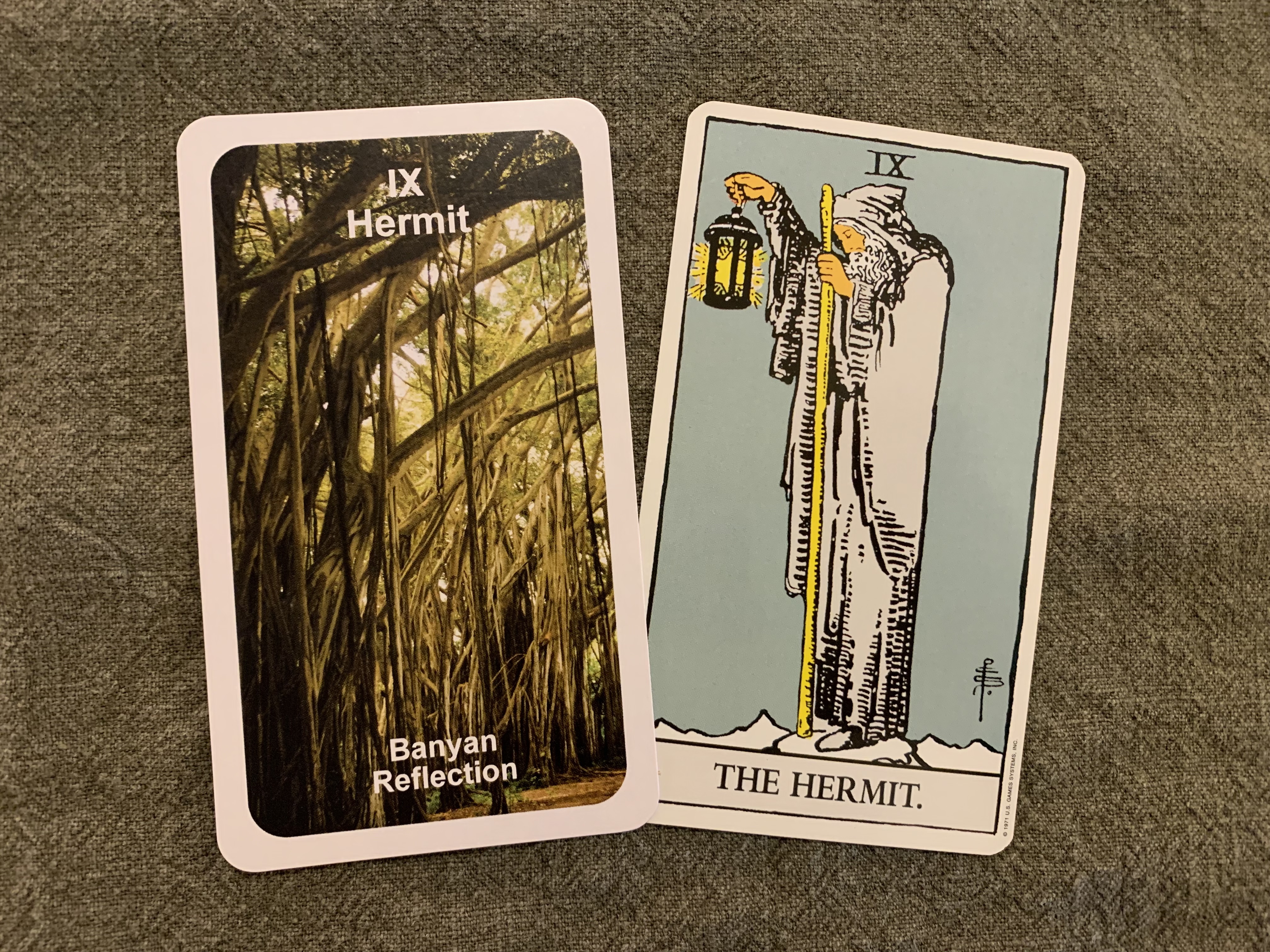
The Hermit card represents that point in our life when we need to block out external forces and listen to our soul before moving forward. It signals a time of becoming self-aware through quiet reflection and meditation in order to hear our inner voice.
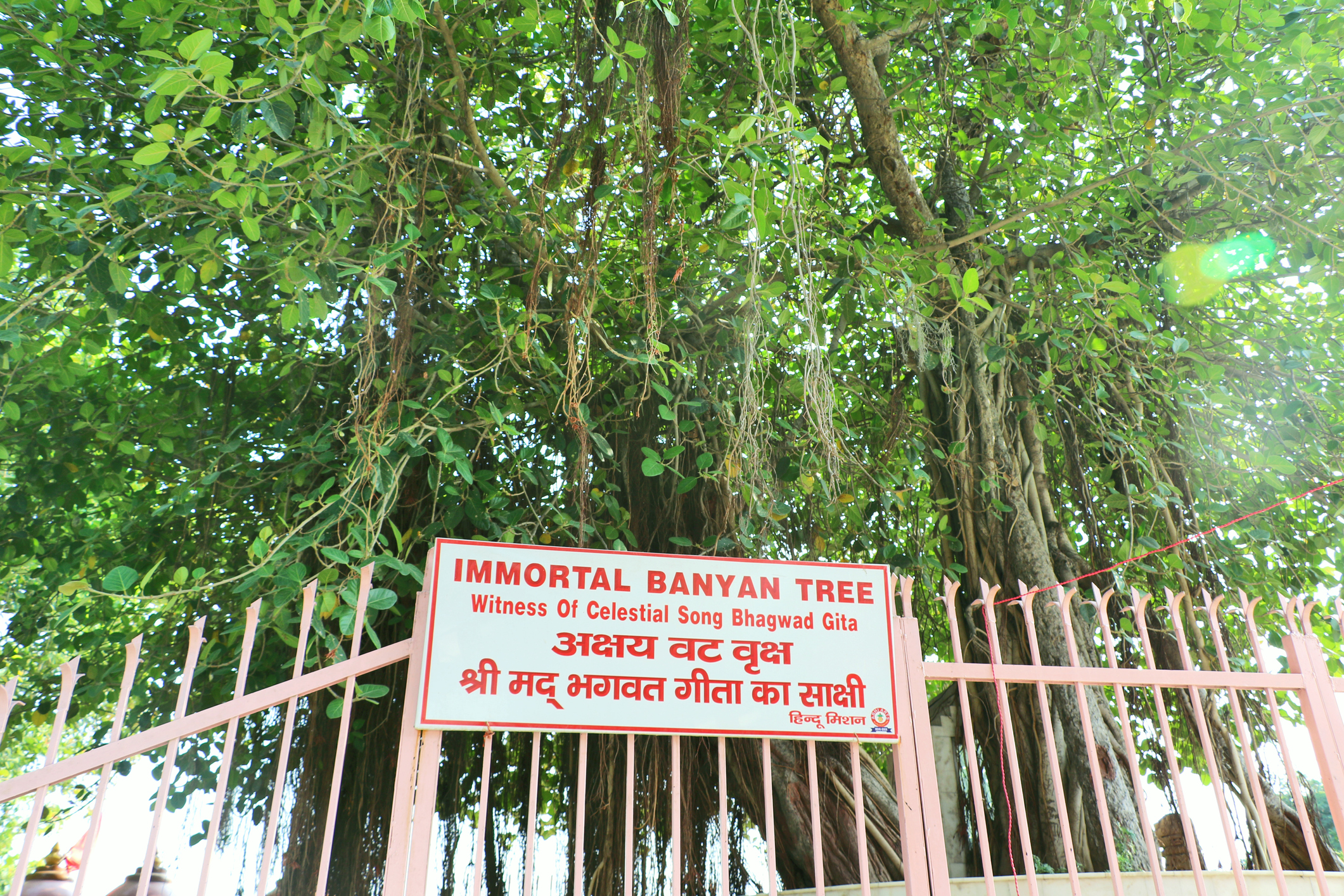
The first time I met a banyan tree in person was 2016 at the Hindu Monastery in Kauai, Hawaii.
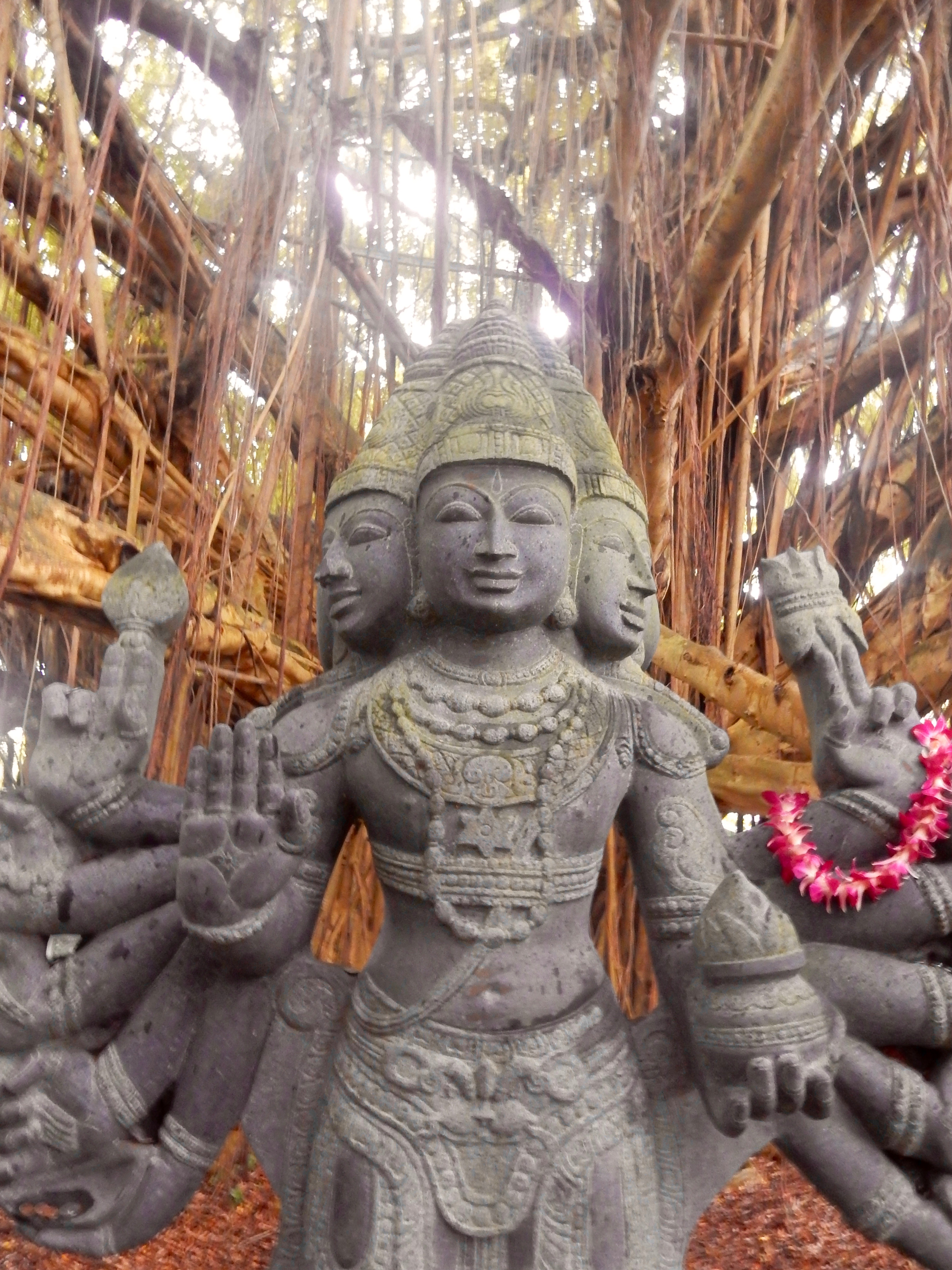
We were in Kauai was for our son’s wedding, which was glorious. But, the day before we flew out, my husband was told that the company he had worked for, for 25 years, was being sold. We knew when we returned to Wisconsin, that our life was about to change.
A few days after the wedding we visited the Kauai Hindu Monastery for quiet reflection. As we entered the gardens we were greeted by a giant banyan tree that felt more like entering a sacred cave. Deep within its embrace was a life-size statue of Lord Shanmuga (protector of knowledge), a Hindu god with six faces and twelve arms. Lord Shanmuga, also known as Kartikeya, Murugan, Subramania and Guha, is the son of Shiva (destroyer) and Pavarti (power). He is the brother of Lord Ganesha (remover of obstacles).
I knew of this place through my mentor Dr. Judith Cornell. She had been my life coach when I was struggling with the idea of leaving my position as President/Creative Director in an agency where I was also a partner to pursue the healing arts. During this time of deep reflection I attended a week-long mandala retreat facilitated by Dr. Cornell at Mt. Madonna, CA. “The Sacred Art of Awakening” was an immersion into silent reflection as we experienced seven individual mandala meditations based on world religions. Judith was a student at the Kauai Hindu Monastery. It was here that she became Rajita Sivananda, in preparation for her final transition on May 8, 2010.
Standing in front of this magnificent banyan tree caused me to reflect on how she encouraged me to follow my soul’s calling and how my husband would now need to follow his. When we returned home, we began to make plans to start over again in Oregon to be near our son and his family.
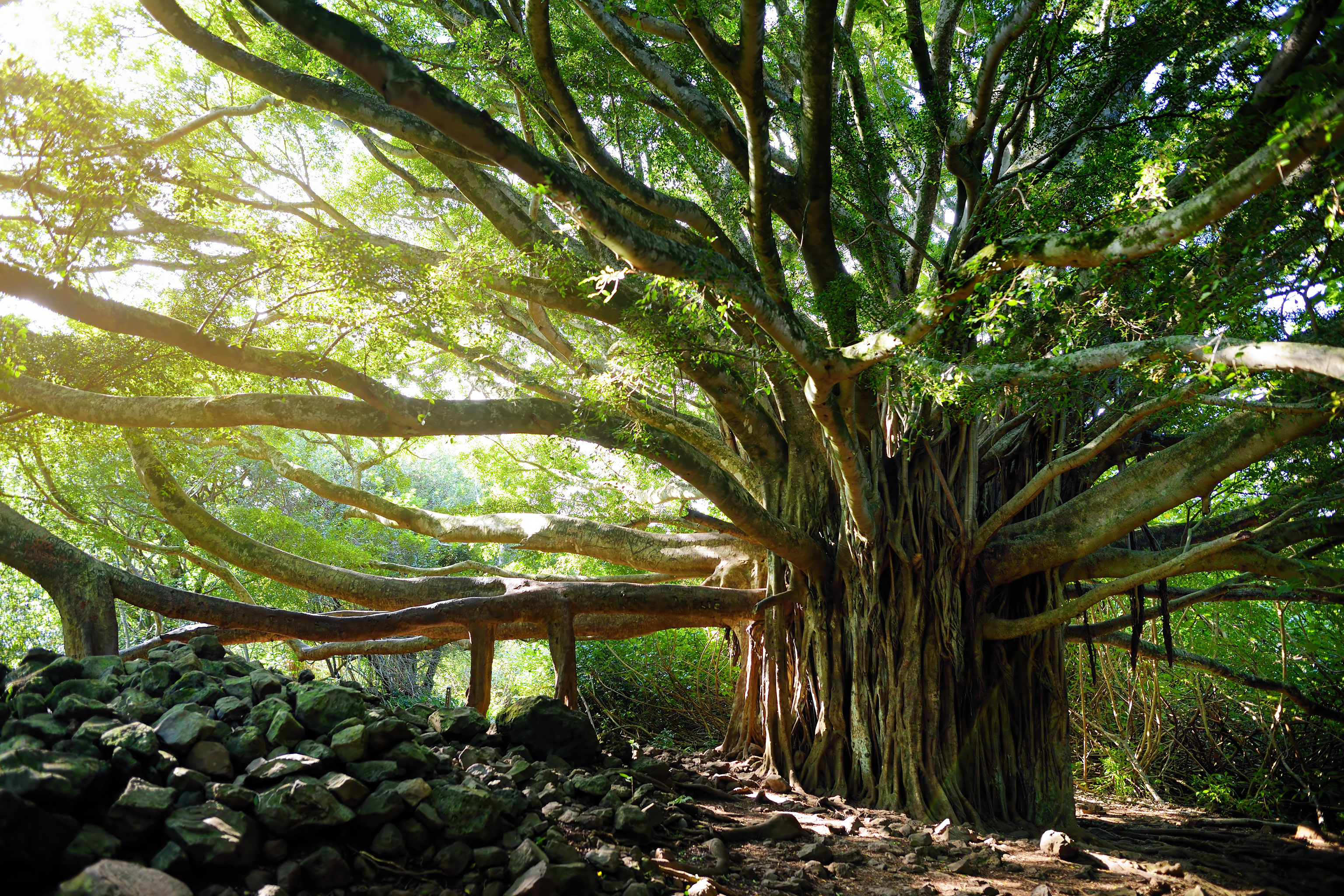
Banyan trees have sprawling branches that produce aerial roots extending to the ground to provide support. These aerial roots create a multi-columned temple covered with a canopy of large, waxy, evergreen leaves. A single banyan can stretch out over several acres.
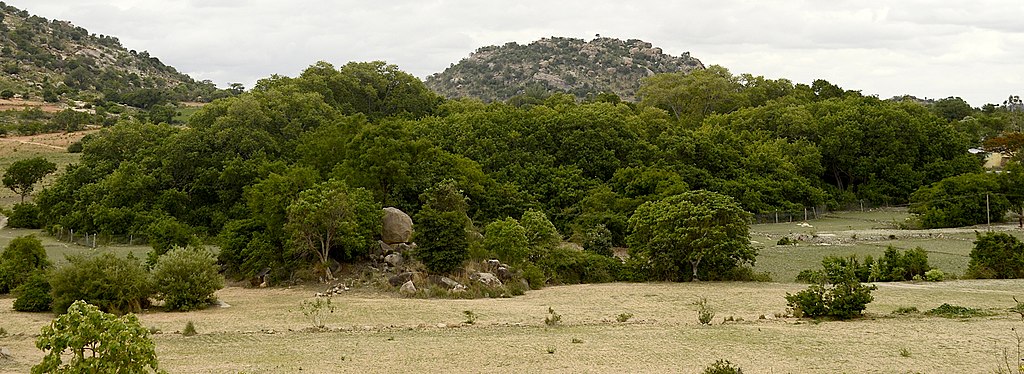
Banyan trees are the biggest trees in the world, in terms of total coverage. The largest banyan tree is in the Indian state of Andhra Pradesh; it covers 4.7 acres and can shelter 20,000 people. The Banyan in Lahaina covers 1.94 acres.
Greek historians wrote of Alexander the Great and his army of 7,000 people taking shelter under a single Banyan tree in 326 BCE.
In Sanskrit the banyan is named —nyagrodha, (the down-grower) or bahupada (the one with many feet). They say banyan trees “walk” on earth.
Banyan is the national tree of India; known as Kalpavriksha (fulfiller of wishes). Per Hindu scriptures, the Trimurti (Trinity) resides in various parts of a banyan. Lord Brahma (Creator) resides in the roots, Lord Vishnu (Protector/Preserver) in the bark, and Lord Shiva (Destroyer) in the branches.
Hindu texts such as the Bhagavad Gita, written between 500 – 200 BCE, describe the banyan (Ashvattha) as the world tree that grows upside-down to bring blessings to humanity.
The banyan tree symbolizes both the eternal self and the embodied self. It is said that Krishna (God of compassion, tenderness and love) read the Bhagavad Gita under a banyan tree. Chapter 15: “There is a banyan tree (Ashvattha) which has its roots upward and its branches down and whose leaves are the Vedic hymns. One who knows this tree is the knower of the Vedas.”
In 1667, English poet John Milton immortalized the banyan tree in his epic poem “Paradise Lost”. He placed the banyan tree in the biblical Garden of Eden and identified its leaves as the ones that were used to clothe Adam and Eve.
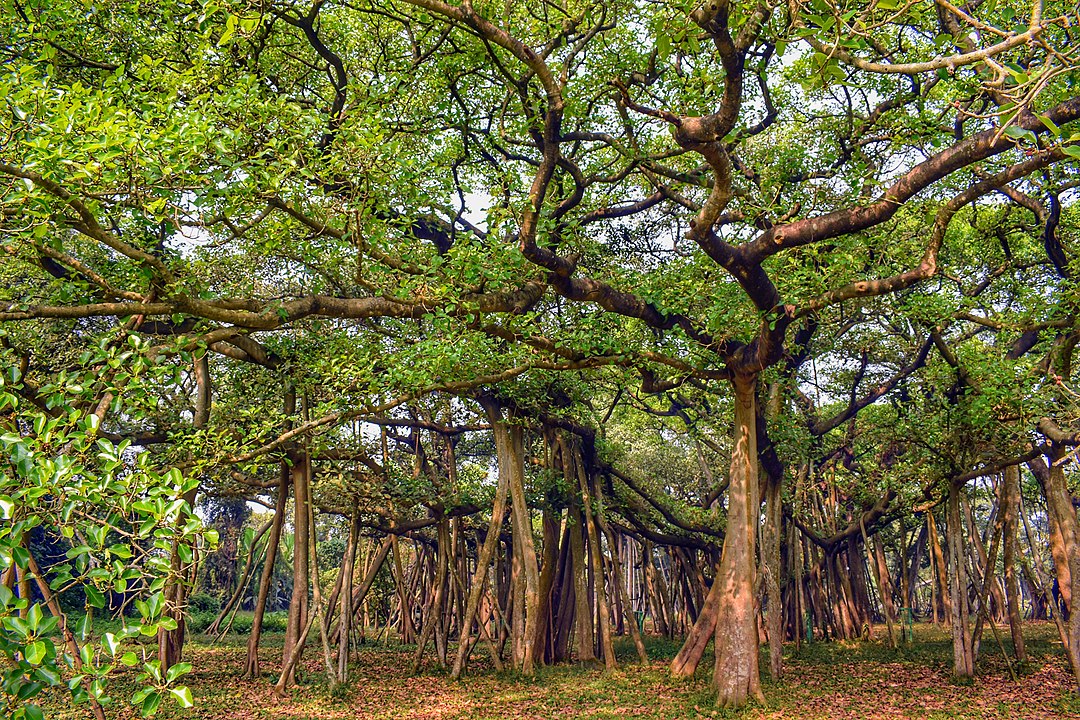
The banyan is one of 850 different species of fig tree. Each species has co-evolved with its own species of wasp. Unlike the common fig Ficus carica, the fruit of Ficus benghalensis is barely edible. Another notable tree in the Ficus genus is the Sycomore fig Ficus sycomorus, the ancient Egyptian fig of the goddesses Hathor, Nut and Isis.

The Indian banyan fig is often confused with the Bodhi tree, ficus religiosa (religious fig). The Bodhi tree is directly associated with Buddhism, which began around 500 BCE when Buddha (Siddhartha Gautama) silently reflected on life under its heart-shaped leaves. Unlike the banyan, the branches of a Bodhi tree reach up and out, versus sending aerial roots down to the ground for support.
Bodhi trees are also known as Peepal or Bo trees. The word Bodhi literally means “tree of awakening.” It’s the shortened version of Bodhi-taru, from the Sanskrit words buddha – “awakened” and taru – “tree.” In PIE (Proto-Indo-European) the word taru evolved into deru, which became treo in Old English. These same words for “tree” also meant “truth, integrity and trust”.
“True” Bodhi trees, must come from the original tree where the Buddha once sat. Shoots have been propagated from successive generations of this tree for over 2000 years.

According to Buddhist belief the Bodhi tree provided Siddhartha Gautama a cool, shady place to rest after a long and difficult journey. As he meditated beneath its canopy, he reflected on his choice of enduring six-years of suffering trying to understand the meaning of suffering. As he sat under the tree he realized that to escape suffering one must choose to release their attachment to suffering. He saw that neither a life of extreme luxury nor a life of strict self-denial allowed one to truly appreciate life itself. He saw this as the “middle path.” This “awakening” transformed him into the Buddha – the “awakened one.” He bowed to this tree in gratitude. His wish was to share his insight with everyone, which he did for forty years, until his death around 480 BCE.
A basic belief in both Hinduism and Buddhism is reincarnation. Samsara (Wheel of Life), is seen as a cycle of repeated birth and death. The goal is to is attain moksha (liberation) from this perpetual cycle, which occurs by becoming one with the eternal soul. By releasing our attachment of feeling “stuck” we can free ourselves from feeling restricted.
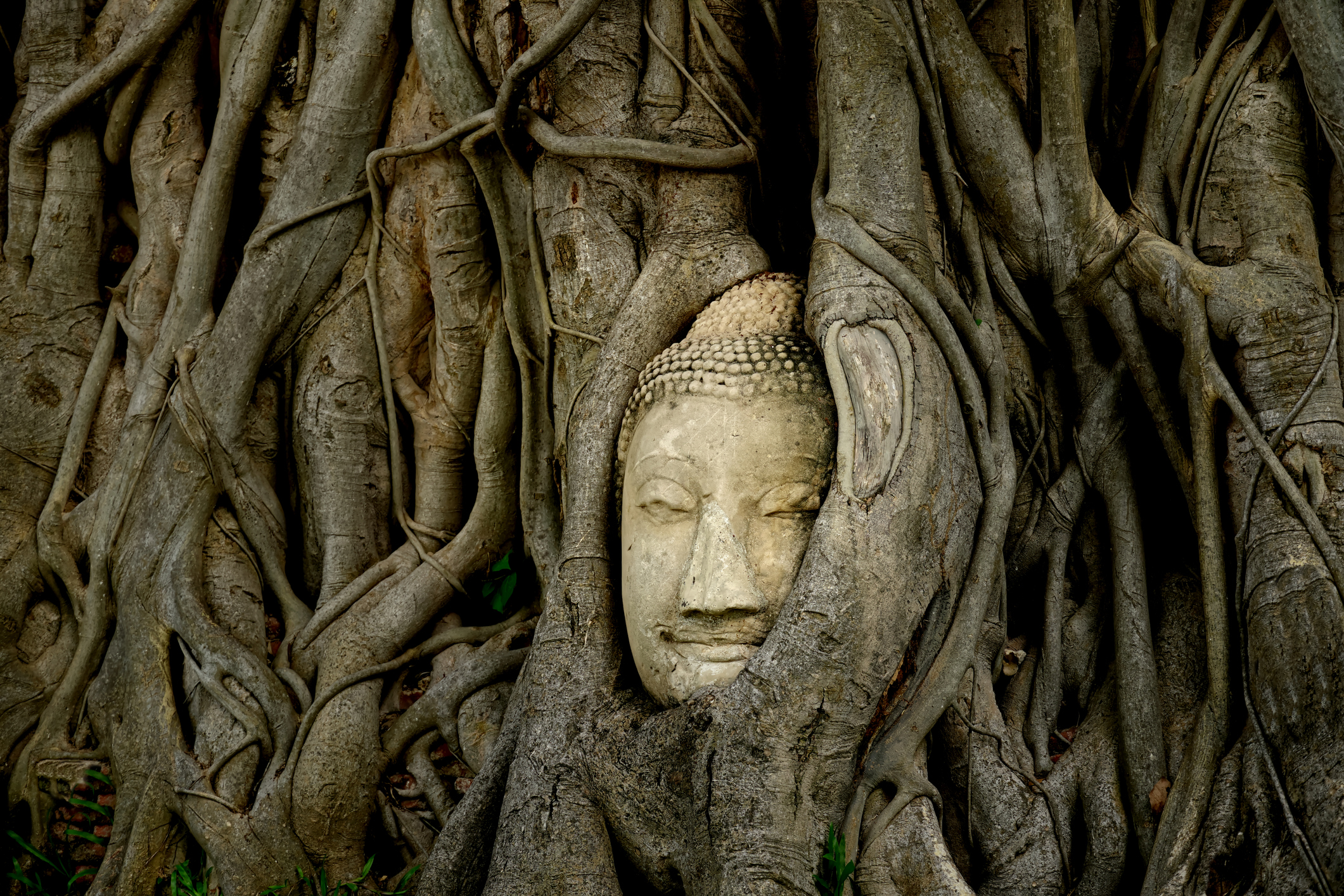
Strangler figs are created by birds that disperse the seed of a banyan onto a host tree. After the seedling germinates its roots grow toward the ground strangling its “host” until it alone survives. This is one of several reasons why banyans are also seen as trees of death and destruction.
The name “Banyan” became associated with this tree around the 1630’s when Portuguese traders referred to Hindu merchants as banias who came from Bombay, India. These Hindu merchants would often set up market places under the shade of a banyan tree, in this case it was a tree in Gombroon (modern Bandar Abbas) along the Persian Gulf of Iran. The Banians, originally known as vanijo’s “merchant” in Sanskrit, were men of the Hindu trading caste. They were vegetarians and had a deep reverence for all animal life.
Banyan and Bodhi trees invite us to reflect on the many paths before us.
Once we settled into our new home in Oregon, I was inspired to create Tree Spirit Tarot as well as this blog. I also became a grandmother, which has given me an entirely new path to explore. A few years later, our son began working for a company named for the banyan tree – Banyan Botanicals. He now travels to India and Kauai to promote sustainable and organic farming for Ayurvedic medicinal plants and trees. It is fascinating when our paths converge in such meaningful ways.
Let us send blessings to all the trees that continue to inspire hope and reflection during these changing times.
Today’s Message: The banyan spirit reminds us to slow down and meditate on where we are now and where we want to go. This is a time to retreat into our self as we reflect on the knowledge we have gained and the path we have chosen. Banyan asks that we embrace this period of isolation as a gift of initiation to ourselves in search of our inner truth, often hidden deep within our subconscious mind. The answers we seek are within us, if we listen to our soul.
Today’s Challenge: If you are feeling isolated, alone, bitter, reclusive or odd, work with the gentle spirit of the banyan tree to help find your way home within yourself.
If you liked what you read and want more... you may be interested in having the actual guidebook and card deck. The 204 page full-color book is sold separately from the cards. My goal is to find a publisher who can offer this as a set. In the meantime, you can purchase either the book or cards via these links.
Thank you for you support. Laural
Tree Spirit Tarot – Return to the Garden of our Soul
Tree Spirit Tarot book available at: Amazon
Tree Spirit Tarot deck available at: Printers Studio
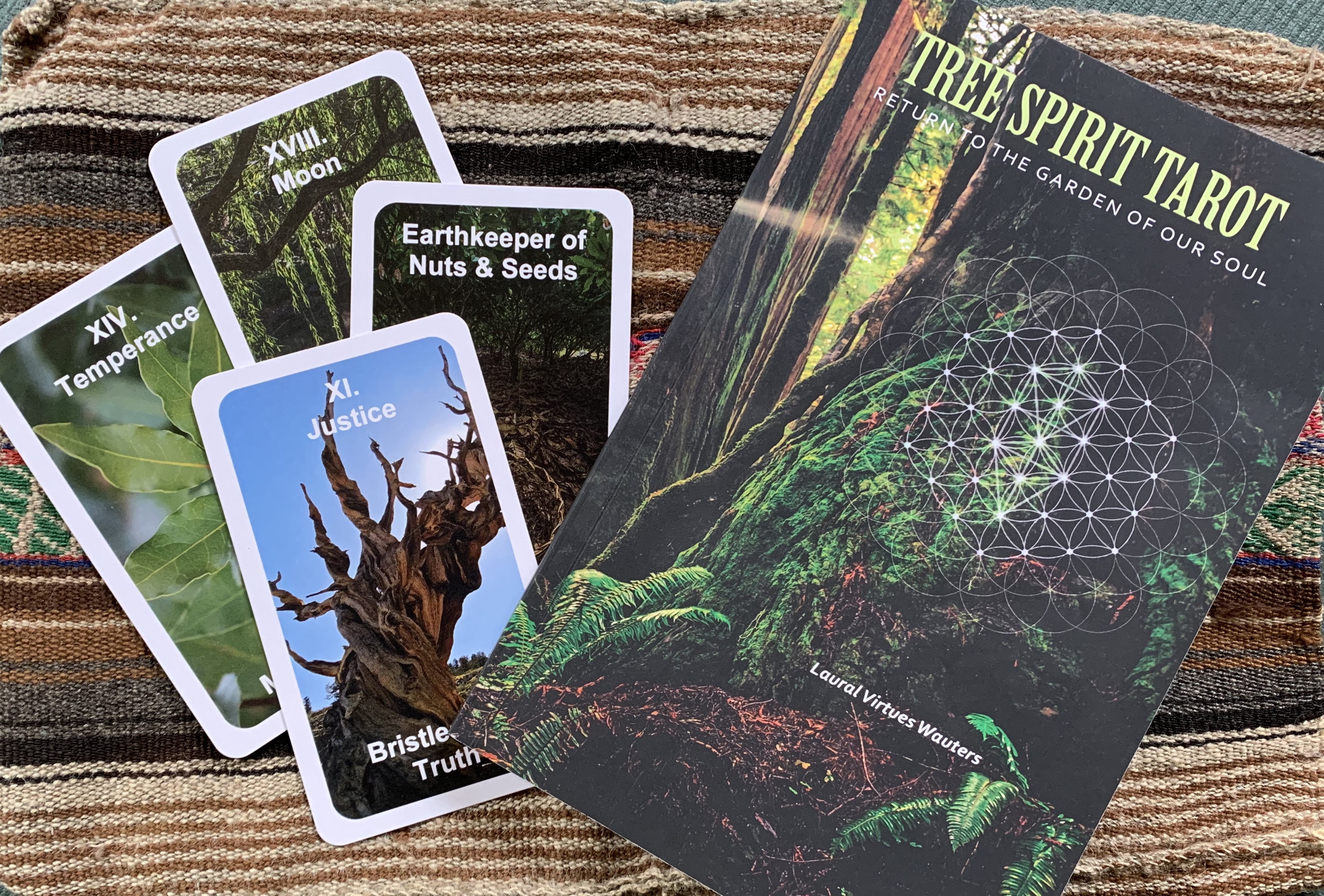
For more information visit: lauralwauters.com
 Tree Spirit Wisdom
3 Comments Add yours