Since moving to Southwestern Oregon in 2017, I’ve been fascinated by two mystical and magical species of broadleaf evergreens, the Pacific madrone (Arbutus menziesii) and whiteleaf manzanita (Arctostaphylos viscida). We are surrounded by mature madrones and manzanitas in the mountains outside of Grants Pass, Oregon. Both of these species thrive in the Rogue River-Siskiyou National Forest within the Klamath-Siskiyou mountain range. Our climate provides cold/wet winters and hot/dry summers, similar to the climate of the Mediterranean basin.
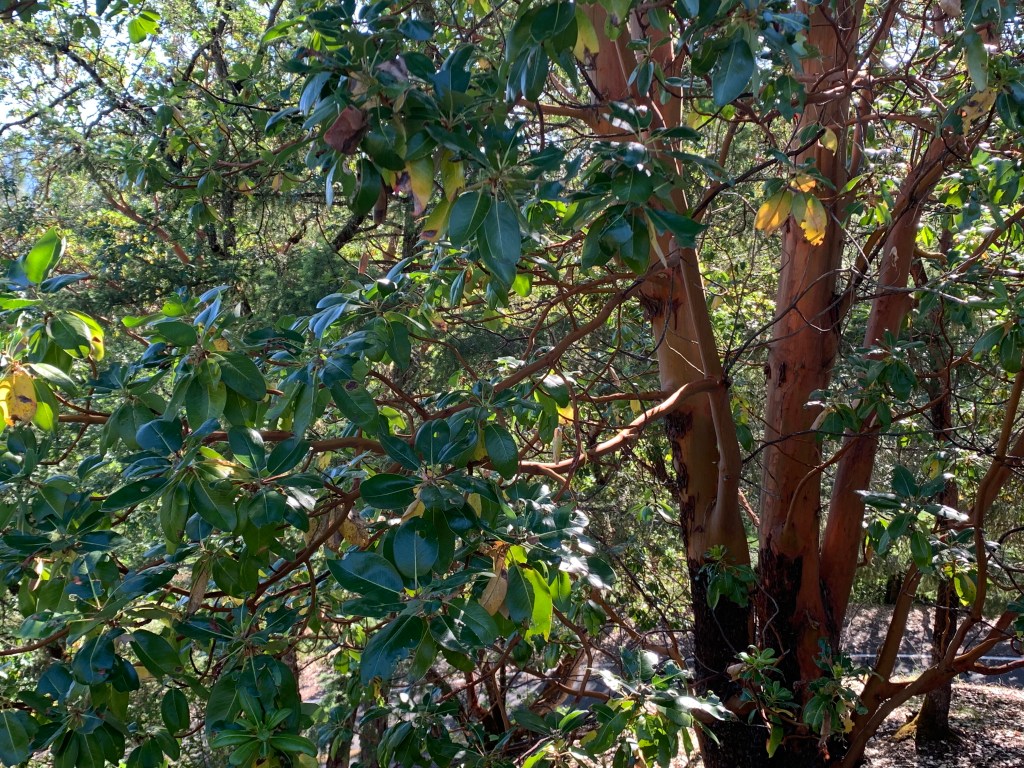
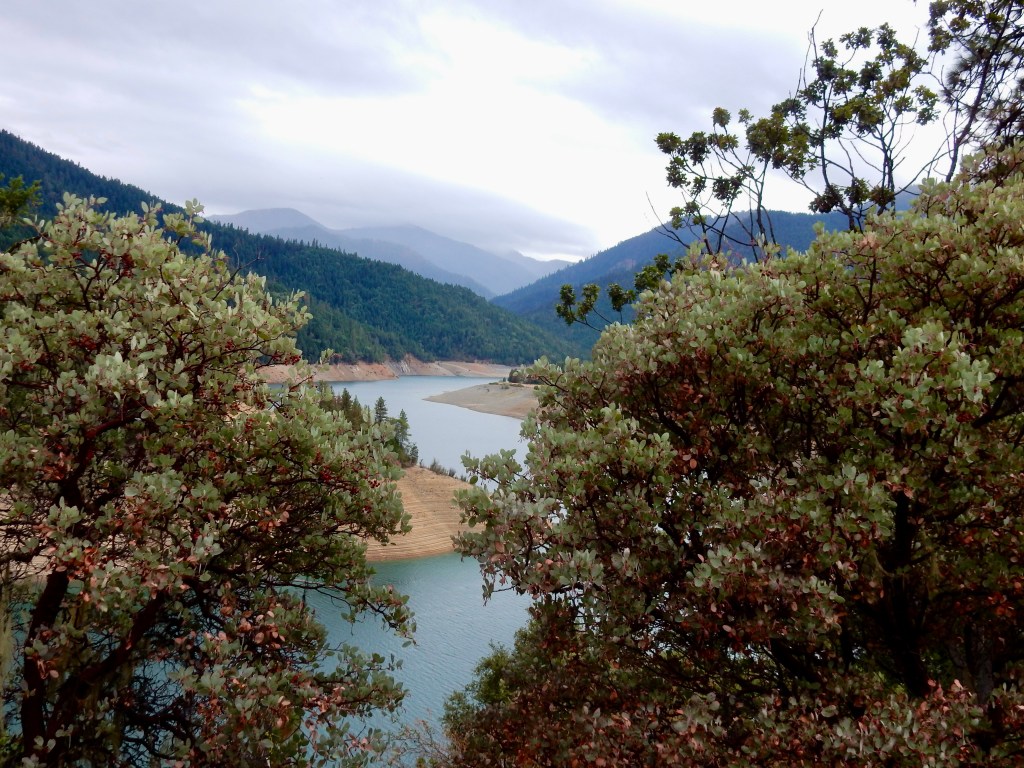
Right: Whiteleaf manzanita, Arctostaphylos viscida – Applegate Lake, Oregon.
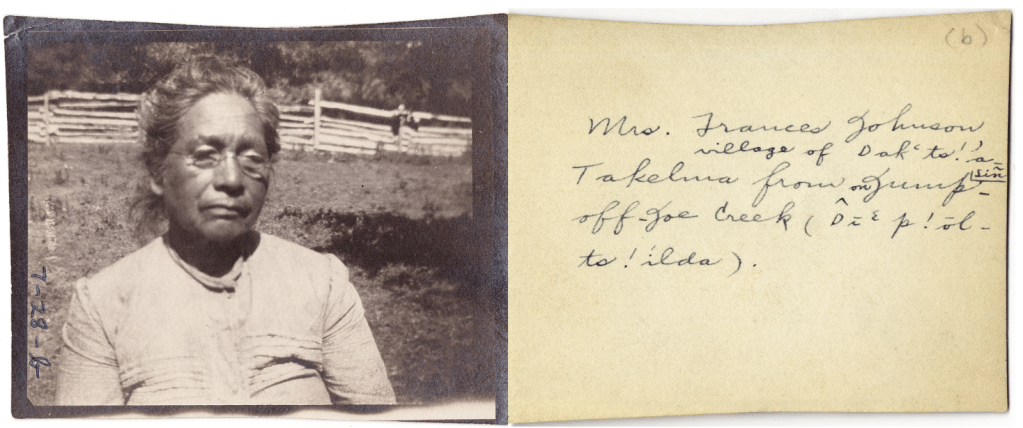
The First Nation people of this land were the Takelma (Dagelma), meaning “people along the Rogue River,” who settled here 15,000 years ago. Their people and their language were virtually extinguished due to the Rogue River Wars and the Gold Rush in the early 1850’s. Little was known about their history or language until Edward Sapir (1884-1939), a German-American linguist and anthropologist, published his notes on the Takelma in 1907. He was able to sit with one of four Takelma speaking women who had been relocated to the Selitz reservation in Northwestern Oregon. Her name was Francis Harney Johnson (Gwisgwashan), (1835-1934). It was through her stories that Sapir was able to piece together parts of the Takelma’s story and its language.
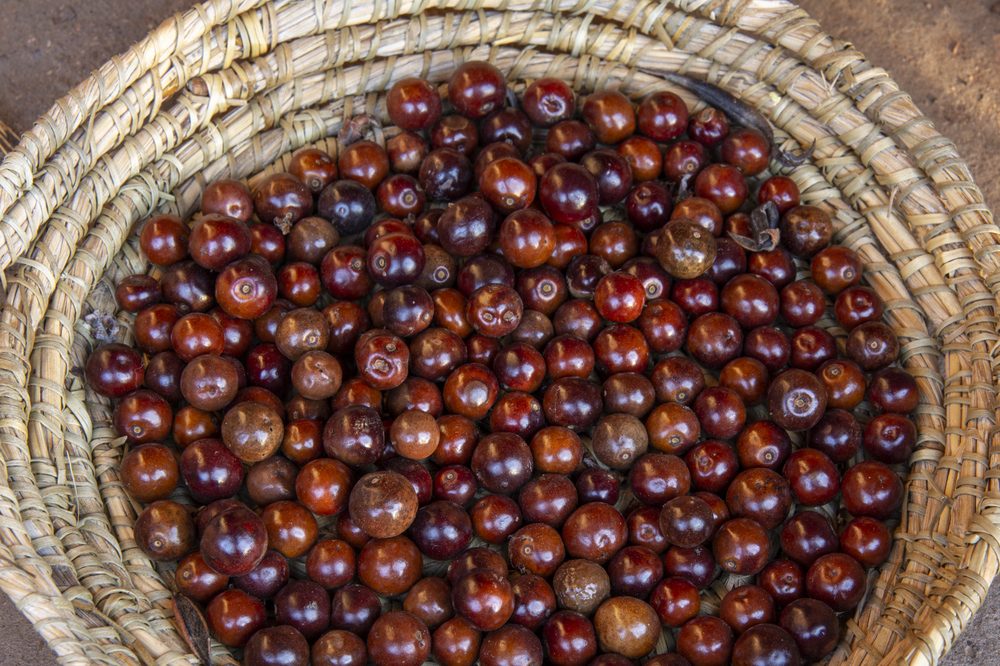
Manzanita berries (loxo-m) were a favorite food of the Takelma, behind salmon (phim), acorns (yana) and camas root (dip). Manzanita berries were eaten fresh or dried and pounded into flour (p’abap) then mixed with sugar pine nuts (t’gal) and set aside for winter. When needed, water was added to make a porridge. Manzanita berries and leaves were also used in teas or to add flavor to other foods.
The most cultivated and popular species of manzanita is Arctostaphylos uva-ursi. Some Native American’s call it kinnikinnick, based on an Algonquin word meaning “mixed.” Kinnikinnick is used in a ceremonial smoking blend of dried Arctostaphylos uva-ursi (bearberry) leaves, dogwood bark, osha root and other aromatic herbs and flowers.
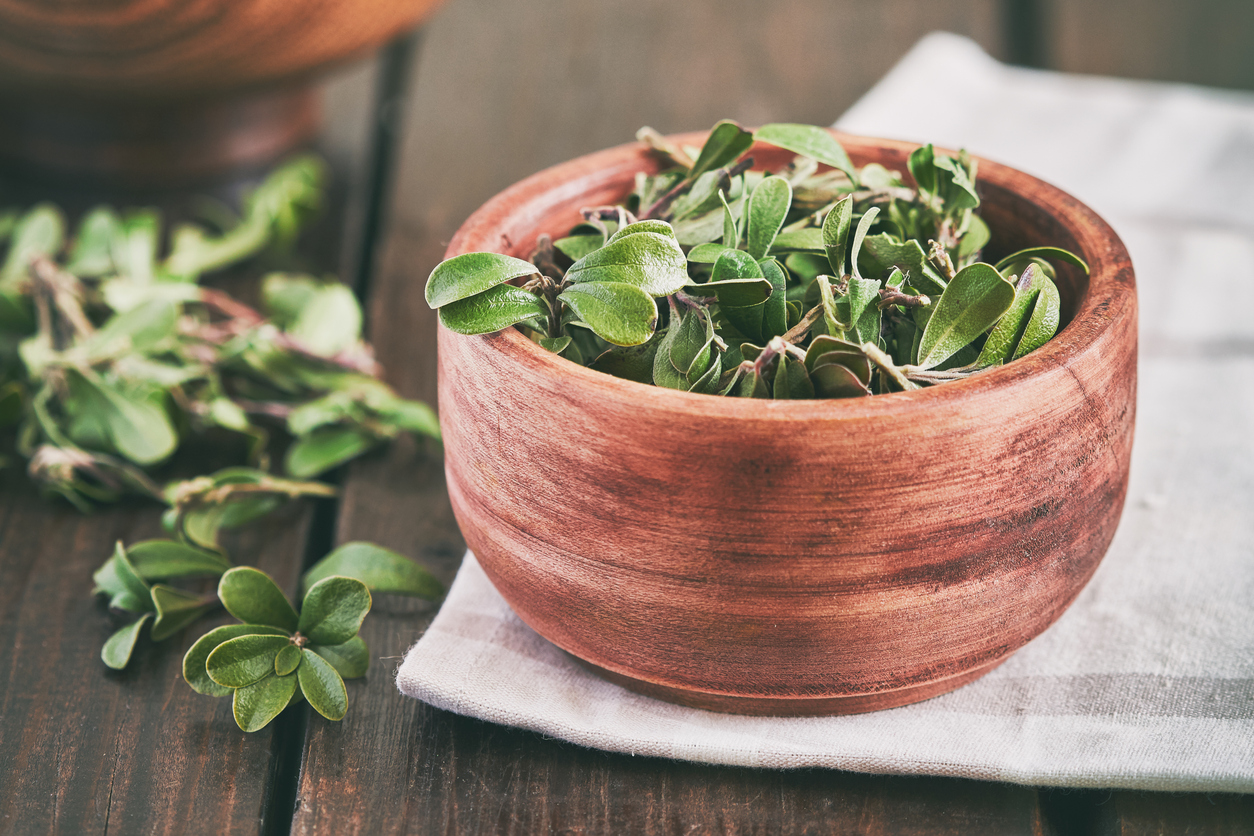
Madrone berries (ts’asap) were not a desired source of food due to their astringent taste, but the Takelma medicine men (Somloholxa’s) may have used the leaves and bark to make medicinal tea to treat colds, skin ailments and gastrointestinal issues. The madrone’s hard, dense wood was used for fire, and to make tools and cooking utensils.
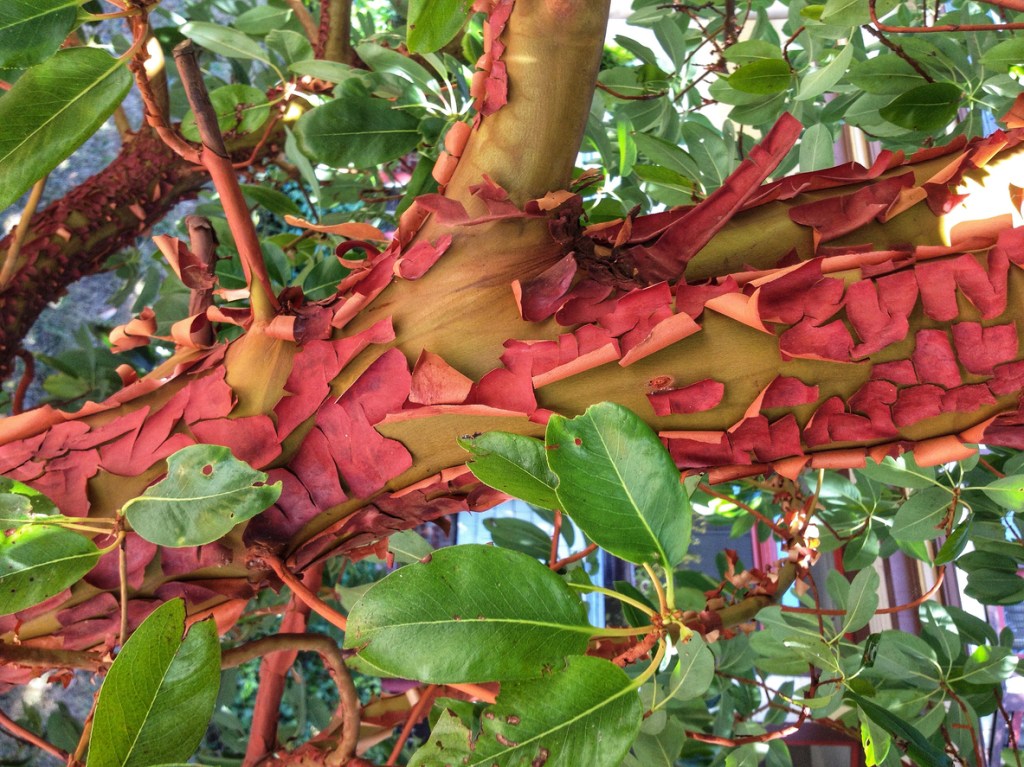
In 1769 Father Juan Crespi (1721-1782), a Franciscan Friar, was the first to name these trees along the Pacific coast as “madrono” based on their resemblance to the Mediterranean madrone “strawberry trees” of his Spanish homeland. He did note that these Pacific madrones were much larger in size, but its fruit was smaller and less palatable.

Note: Madrone and Manzanita are Spanish words:
- Madrone = “strawberry tree.”
- Manzanita = “little apple.” (manzana “apple” & ita “little”)
Both Pacific madrone and whiteleaf manzanita are stunning trees with peeling smooth bark, twisted aerial branches, urn-like blossoms and red berries. Their native habitat is found along the west coast of North America. These similarities can often make it difficult to tell them apart, in fact many people still refer to them interchangeably as madrone, manzanita, arbutus or bearberry.
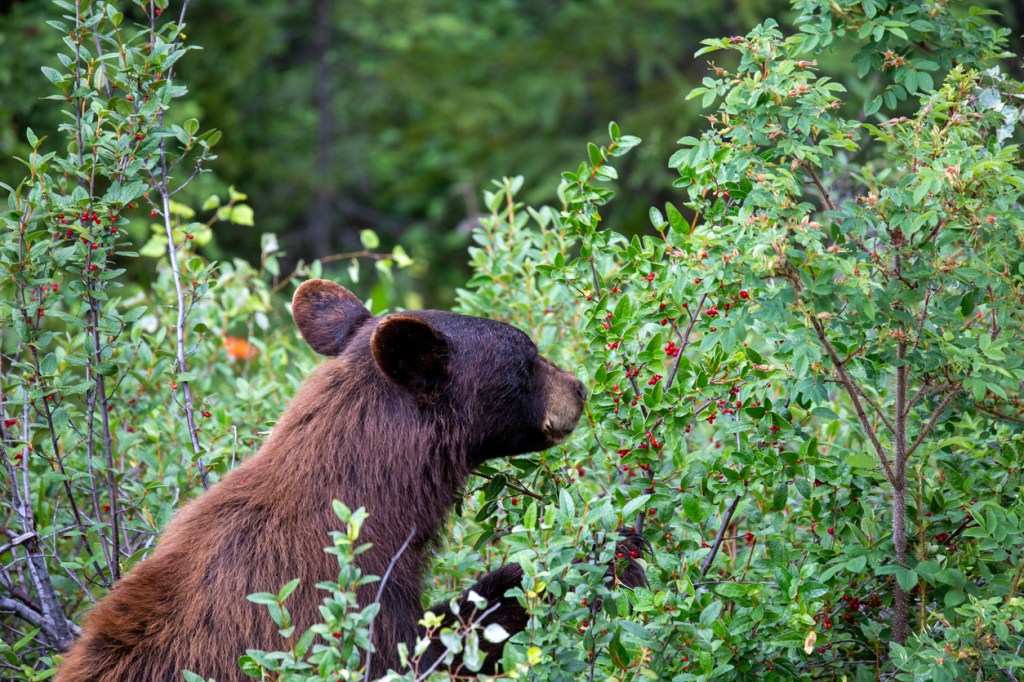
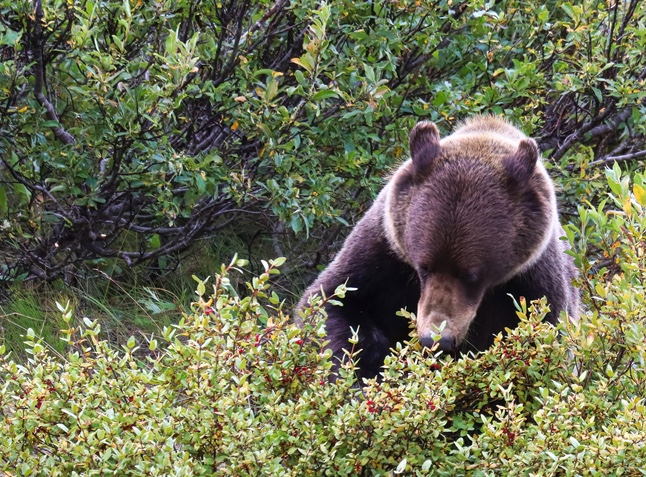
The shared name “bearberry” comes from the fact that all bears love berries. As members of the Ericaceae (heather) family, madrones and manzanitas are each prolific providers of berries in the wild. They share this distinction with other species in their family such as; blueberries, cranberries, lingonberries and huckleberries.
By comparing these two species side by side we can begin to learn how to tell them apart.
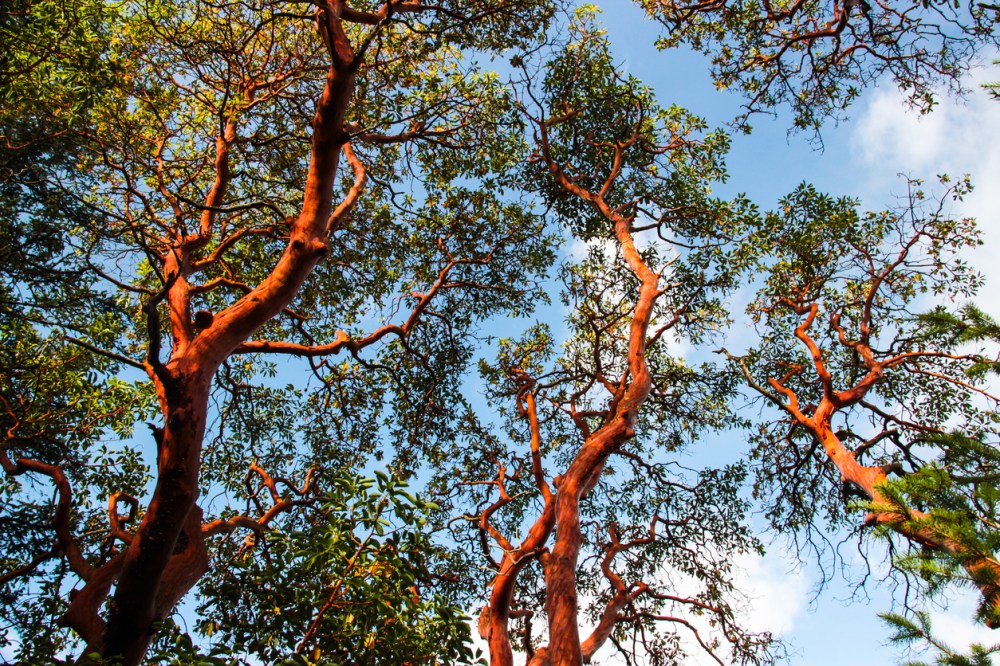
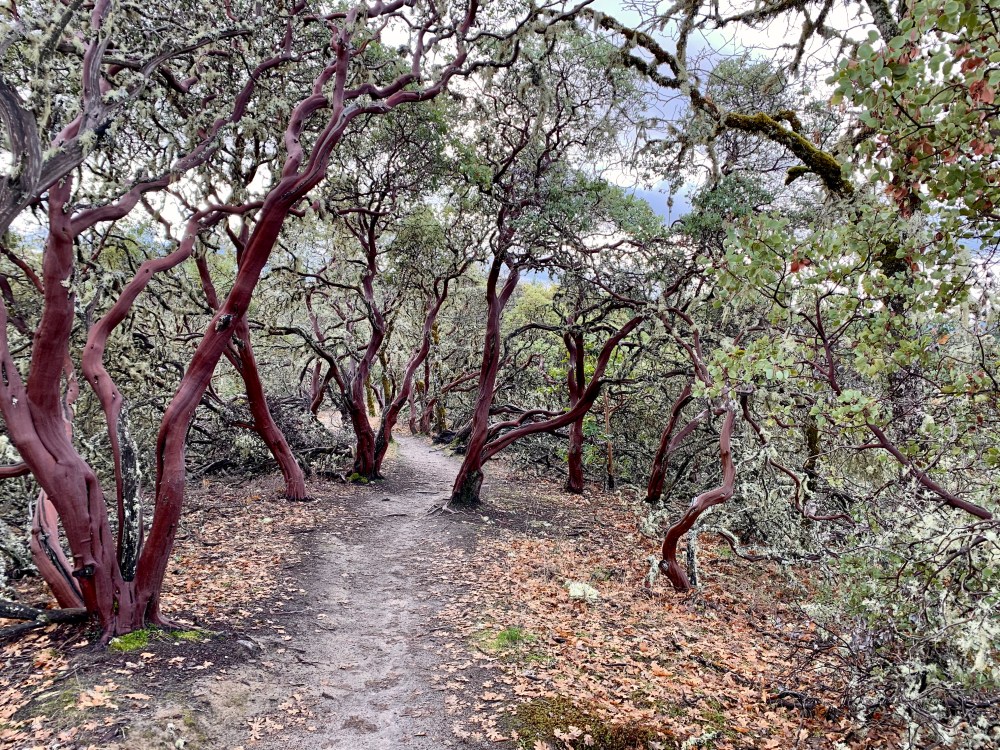
Right: Whiteleaf manzanita (Arctostaphylos viscida) – Cathedral Hills, OR
- Pacific Madrone – are large trees with sprawling canopies that can grow over 100 feet tall.
- Whiteleaf Manzanita – are smaller trees or shrubs that rarely grow beyond 15 – 20 feet.
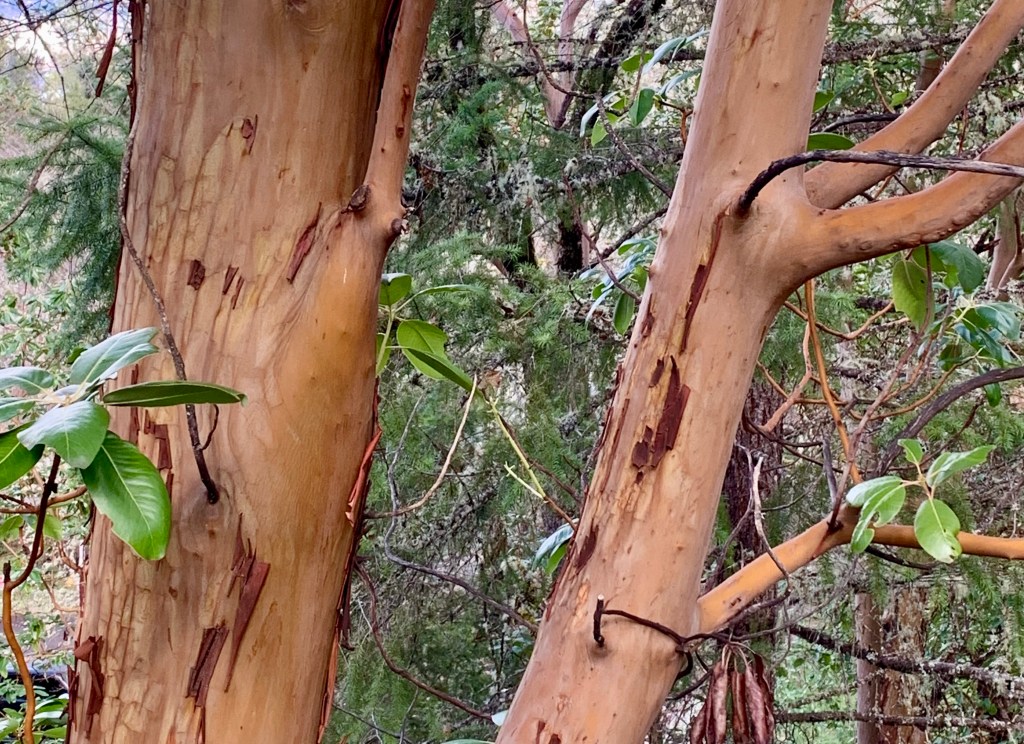
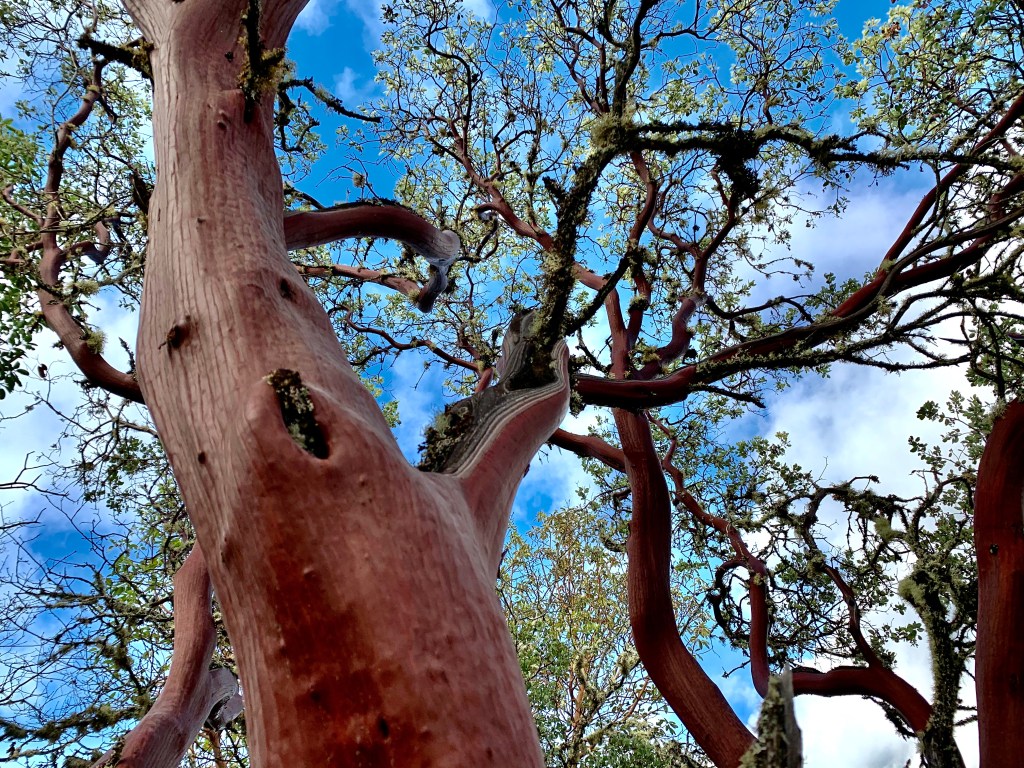
Right: Whiteleaf manzanita (Arctostaphylos viscida) – Cathedral Hills, OR
- Pacific Madrone – peeling bark reveals lighter, smooth reddish-orange bark.
- Whiteleaf Manzanita – peeling bark reveals darker, smooth reddish-brown bark.
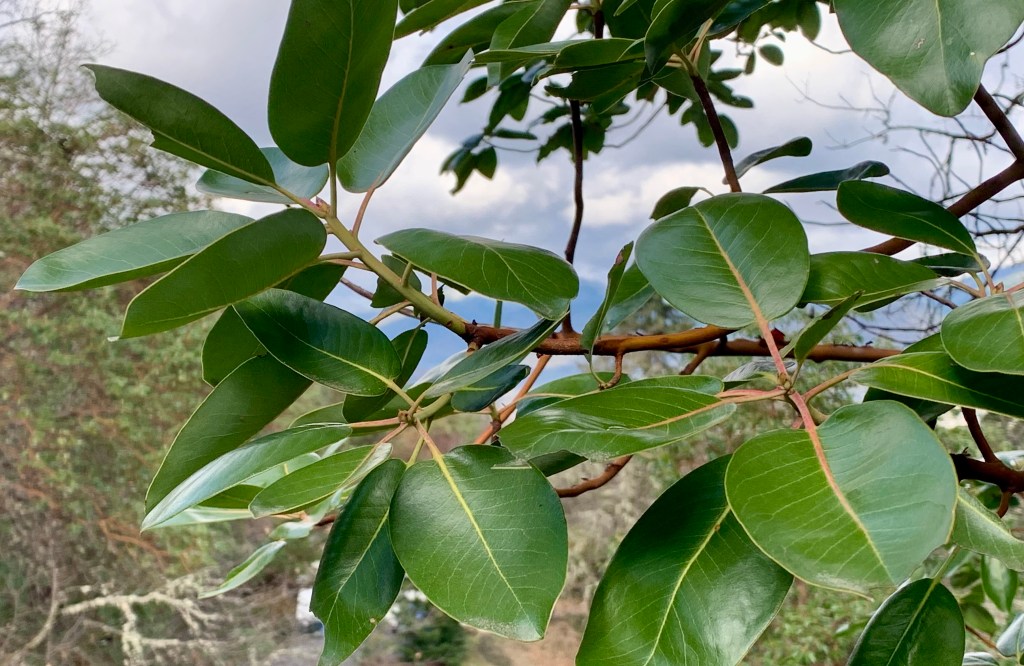
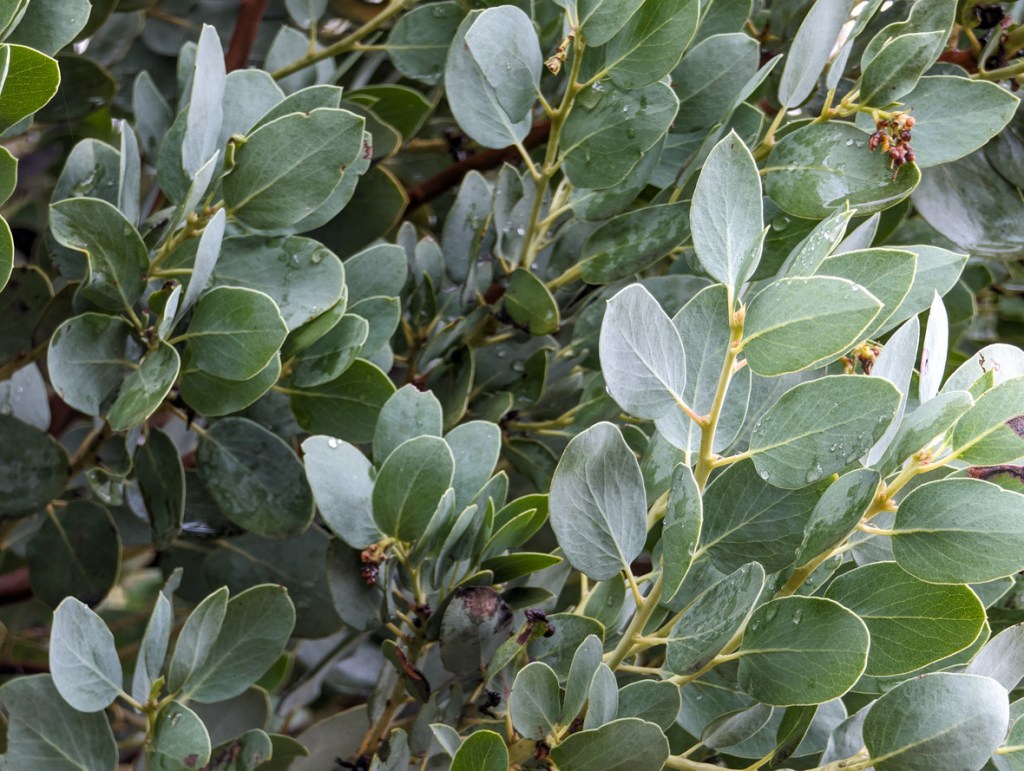
Right: Whiteleaf manzanita (Arctostaphylos viscida) leaves – San Gabriel Mountains, California
- Pacific Madrone – have large waxy, deep green leaves measuring between 3-5 inches. The leaves are leathery and smooth to the touch.
- Whiteleaf Manzanita – have smaller dull/dusty gray-green leaves measuring between 1-2 inches. The leaves of whiteleaf manzanita reflect headlights at night with a silvery glow.
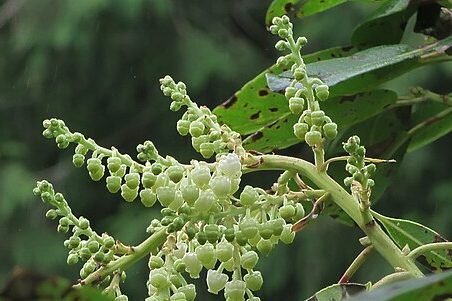
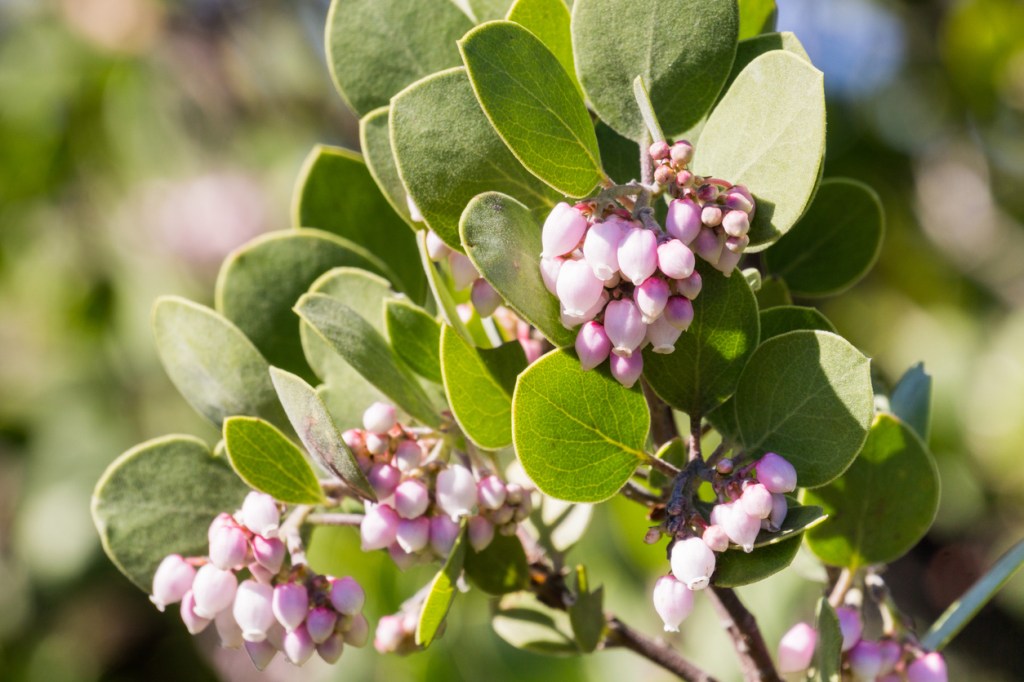
Right: Whiteleaf manzanita (Arctostaphylos viscida) flowers – California
- Pacific Madrone – produce large sprays of small white or pink urn-shaped flowers in spring,
- Whiteleaf Manzanita – produce drooping clusters of small white or pink urn-shaped flowers spring.
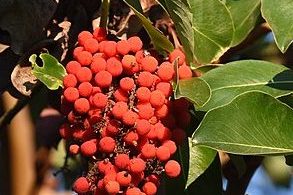
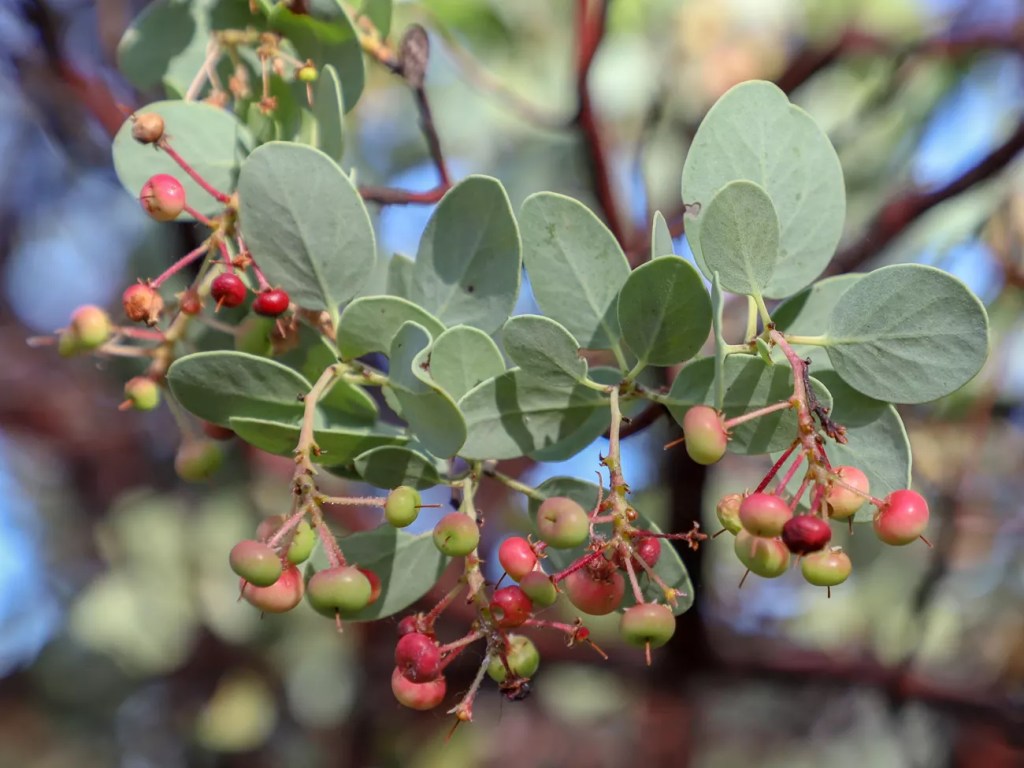
Right: Whiteleaf manzanita (Arctostaphylos viscida) berries – Leia Althauser
- Pacific Madrone – small red berries that resemble small strawberries with a rough texture.
- Whiteleaf Manzanita – small red berries resemble blueberries with a smooth texture.
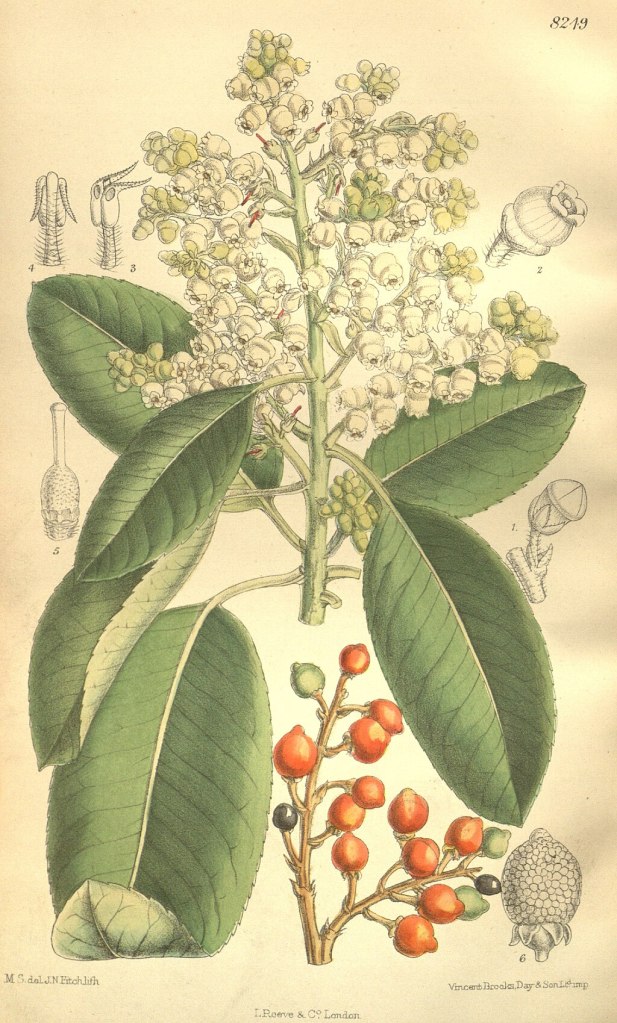
Looking into the botanical history of madrone trees, I discovered that the Mediterranean madrone (Arbutus unedo) has been called “the strawberry tree” since classical antiquity, because its fruit resembles a strawberry. In Ancient Greece it was called komoros, in Italian it is known as corbezzole, in Latin it became Arbutus. This Mediterranean madrone is a smaller ornamental tree or shrub that grows between 15-25 feet tall, versus the Pacific madrone that can reach over 100 feet tall. Although the fruit of Mediterranean madrone is considerably larger at 1″ in diameter vs Pacific madrone.
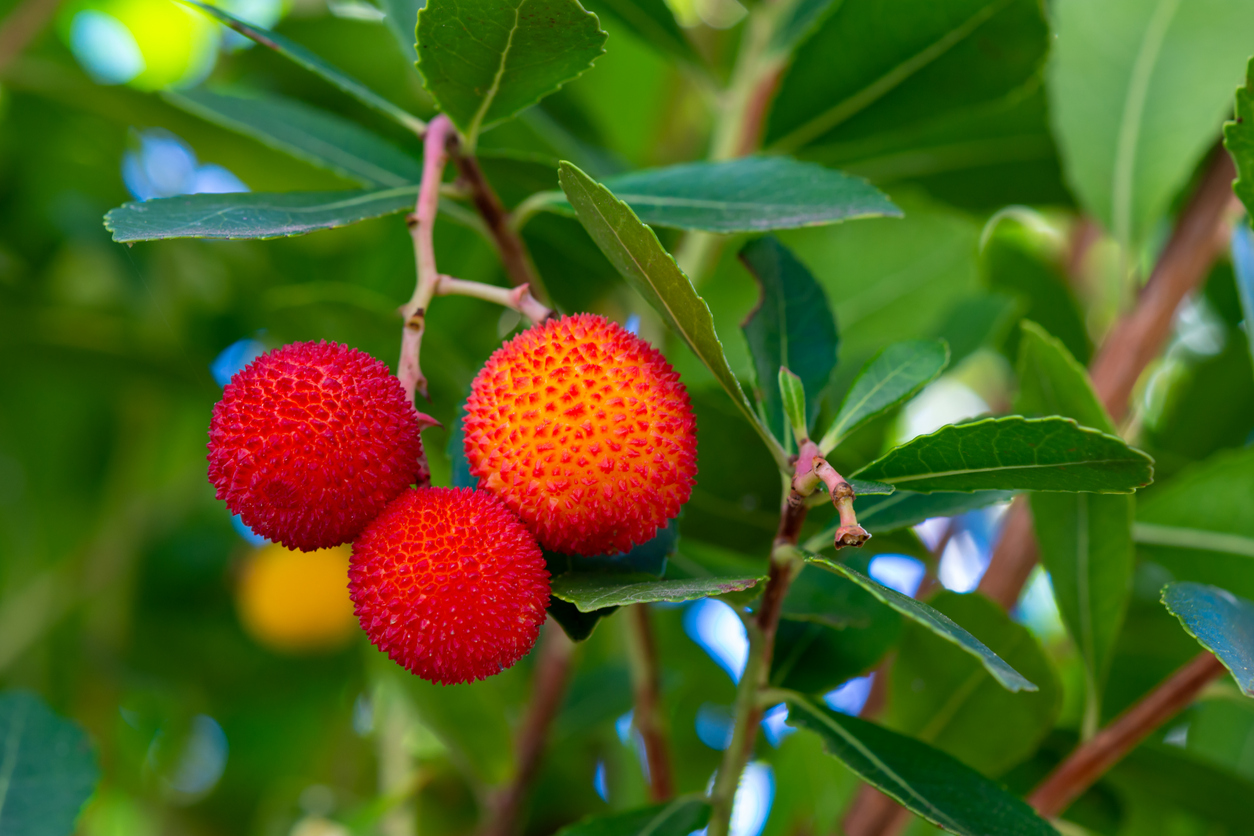
The Mediterranean madrone was well documented by Greek and Roman historians, poets, physicians and botanists:
- Theophrastus – (Greek botanist c. 371-287 BCE) wrote about a tree he named Andrachne, meaning “wild strawberry” in his published work, Historia Plantarum (Enquiry into Plants).
- Virgil – (Roman poet c. 70 – 20 BCE) wrote about bees grazing on strawberry-tree blossoms in his book Georgics IV. “But at night the weary young carry back sacs filled with thyme: they graze far and wide on the blossom of strawberry-trees, and pale-grey willows, and rosemary and bright saffron.” – Fighting Swarms:67-102
- Pedianos Dioscorides – (Roman physician c. 40-90 CE) mentioned “strawberry trees” in his published work De Materia Medica, as a curiosity in terms of “strawberries” that grow on the ground and in a tree. He saw it as a temptation, that offered little medical value.
- Ovid – (Roman poet c. 43 BCE-18 CE) is most known for his books Metamorphoses. He wrote of the strawberry tree during the “Golden Age of humans” when they were “Contented with food that grew without cultivation, they collected mountain strawberries and the fruit of the strawberry tree, wild cherries, blackberries clinging to the tough brambles, and acorns fallen from Jupiter’s spreading oak-tree..” – Ovid’s Metamorphoses, Book I:89-112.
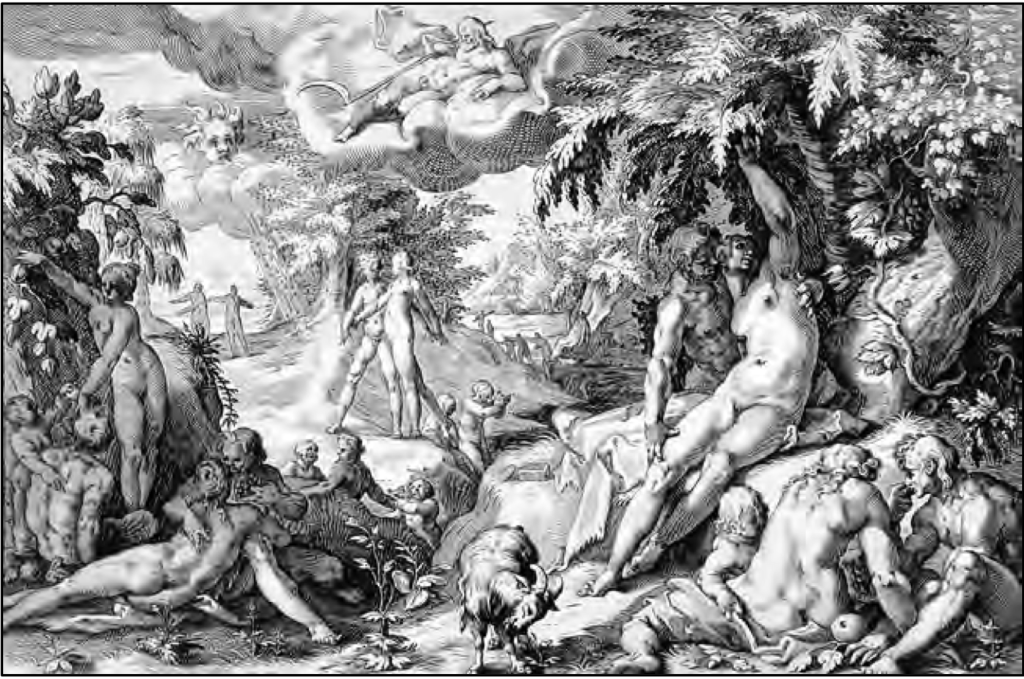
Courtesy of the public domain collections of the Los Angeles County Museum of Art.
In 1753 Carl Linnaeus, (Swedish botanist, 1707-1778) the “father of modern taxonomy” published his landmark book Species Plantarum. He placed madrone and manzanita together in the Arbutus genus, in the Ericaceae (heath) family.

Linnaeus classified Arbutus unedo (strawberry tree) as the type species in the Arbutus genus, which included Arbutus uva-ursi (bearberry tree) and Arbutus andrachne (wild strawberry tree). The name Arbutus comes from the Latin word arbor meaning “tree.” The species name unedo is attributed to Pliny the Elder (Roman naturalist, 23-79 CE), who allegedly said of its fruit “unum tantum edo,” meaning “I eat only one.” This may be based on the fact that its fruit was not that desirable.
In 1763, Michael Adanson (1707-1778) removed Arbutus uva-ursi from the Arbutus genus in his published work Familles des plantes (The Plant Family). Based on his studies of European uva-ursi, he established a new genus named Arctostaphylos (Greek: arctos (bear) and staphyle (bunch of grapes).
He officially renclassified Arbutus uva-ursi as Arctostaphylos uva-ursi. The name uva-ursi is based on the Latin words: uva (grape) and ursus (bear). By doing this, Adanson effectively honored uva-ursi’s original connection to its “bearberry” roots.
In 1792, Archibald Menzies (1754-1842) a Scottish surgeon and botanist gathered specimens along the coast of the Pacific Northwest. He noted the unique botanical differences between Mediterranean madrone (Arbutus unedo) “Strawberry Tree” and the Pacific madrone. He called this new species the “Oriental Strawberry Tree.” In 1814, the German-American botanist Fredrick Pursh (1774-1820) officially named Pacific madrone Arbutus menziesii in honor of Archibald Menzies.
The Pacific Madrone (Arbutus menziesii) is known by several names:
- Madrone – South of the Siskiyou Mountains
- Madrona – North of the Siskiyou Mountains
- Arbutus – Canada
- Refrigerator Tree – (due to its smooth bark feeling cool to the touch).
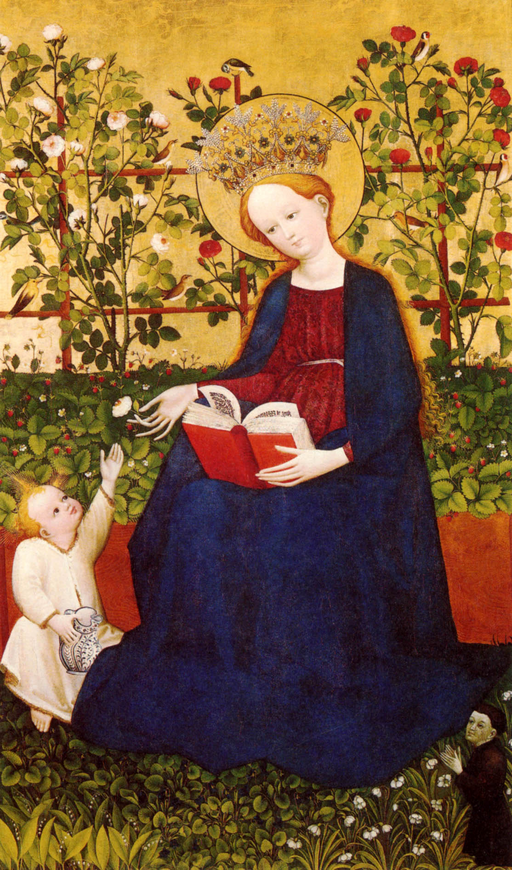
The word “madrone” comes from the Spanish madroño, meaning “strawberry tree,” while “madrona” comes from madroña, meaning “indulgent mother.” I was curious about the connection between “strawberry trees” and “strawberries” and discovered that during the Medieval Period (400-1400 CE) strawberries were often associated with the Madonna or Virgin Mary. The name Madonna comes from the Italian phrase ma donna, meaning “my lady,” In Spanish, it’s madona. In this sense, strawberries and strawberry trees were symbols of virtue, sweetness, innocence and beauty. Similar to Ovid’s “Golden Age” of humans.
On the other hand, strawberries and the “strawberry tree” were also symbols of indulgence, temptation and gluttony. An interesting yet surreal connection between strawberries and the “strawberry tree” can be found in the famous triptych painted by Hieronymus Bosch (Dutch artist c. 1450 – 1516). The central panel depicts a scene of humankind devolving into madness between Paradise and Hell.

In 1517, a year after Bosch’s death, the painting was named “The Garden.” In 1568 Spanish general, Fernando Alvarez de Toledo, confiscated the painting from William the Silent during the Eighty Years’ War. Alvarez brought it to Spain where it became the property of Don Fernando. In 1591, King Philip II of Spain, acquired the painting and placed it in El Escorial, his royal monastery. He renamed it Del Modrono “The Strawberry Tree.”
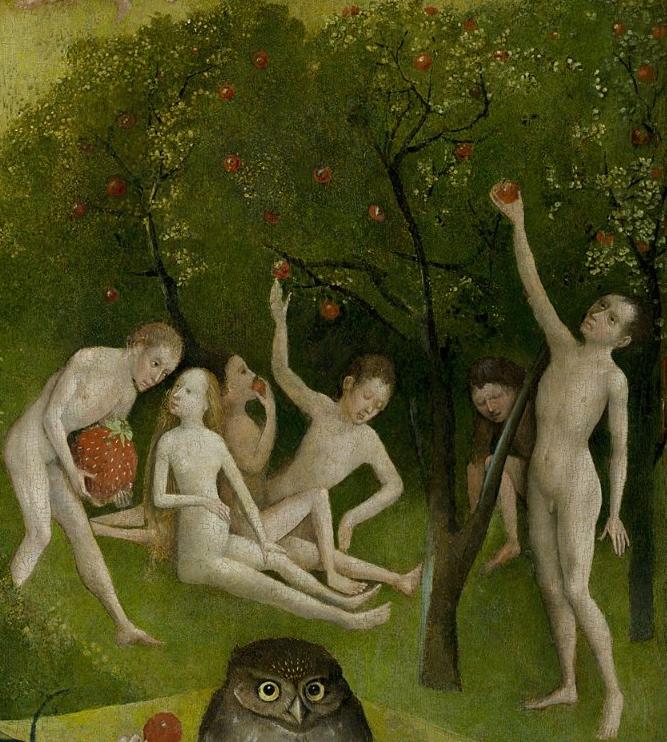
In 1939 the painting was moved to the Prado Museum in Madrid, Spain. In 1947 “The Strawberry Tree” was renamed “The Garden of Earthly Delights.”
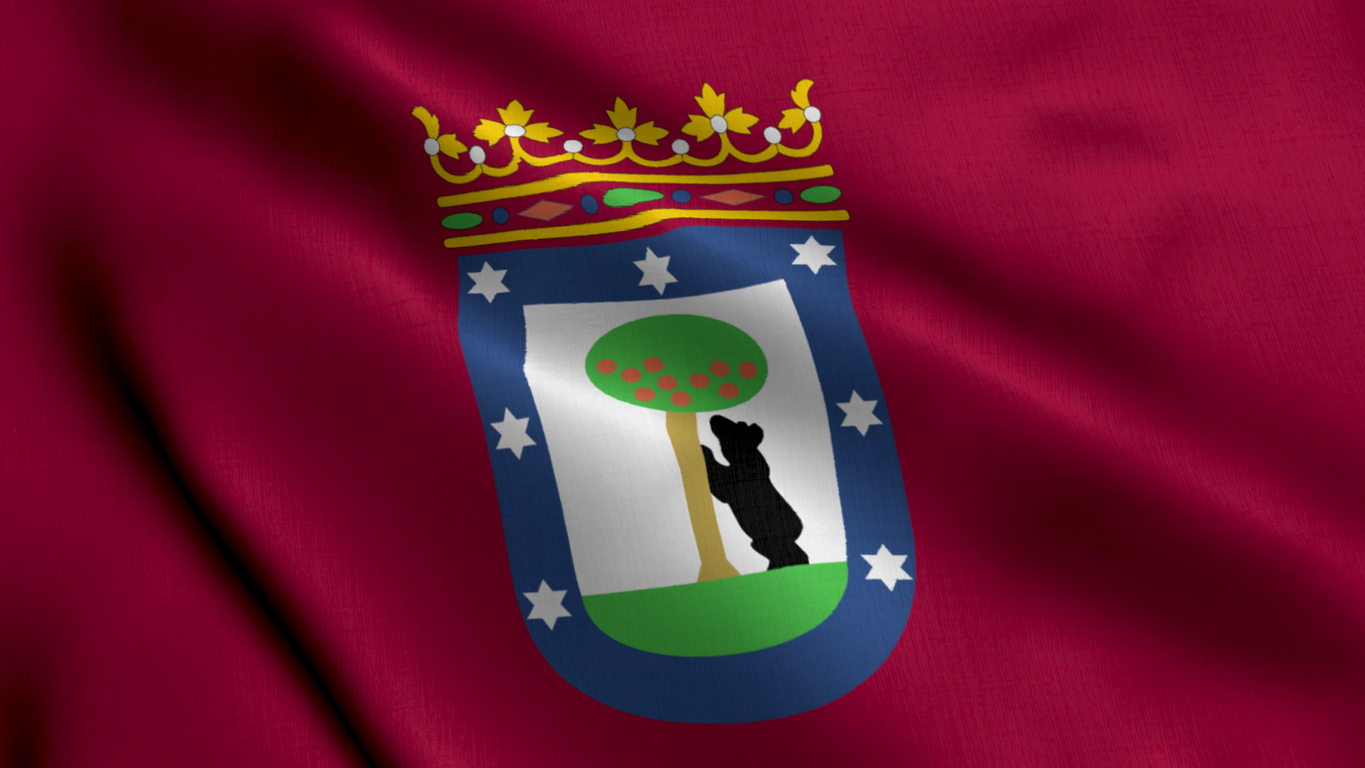
Spain’s affinity with “strawberry trees” Arbutus unedo, and its connection to Madrid can be traced back to the founding of Madrid itself. During the early Roman period (218-409 CE), this area was known as Ursulia, meaning “place of bears.” It was named Majrit in 852 when it became a Muslim fortress. In 1085 CE, Madrid was conquered by the Christian King, Alfonso VI of Castille. In 1212 the Roman name Ursulia inspired Madrid’s coat of arms, featuring a bear with seven stars, representing the constellation Ursa Major “large bear” also known as the Big Dipper. (Note: the stars may also represent Ursa Minor “little bear” as in Little Dipper).
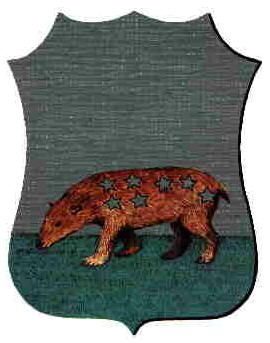
In 1222 the madroño tree (strawberry tree) was added to symbolize unity between the Catholic Church and Madrid’s city council. King Alfonso VIII chose the bear as a symbol of the church, while the madroño “strawberry tree” symbolized the city. Madrid became the capital of Spain and center of the Spanish Empire in 1561.
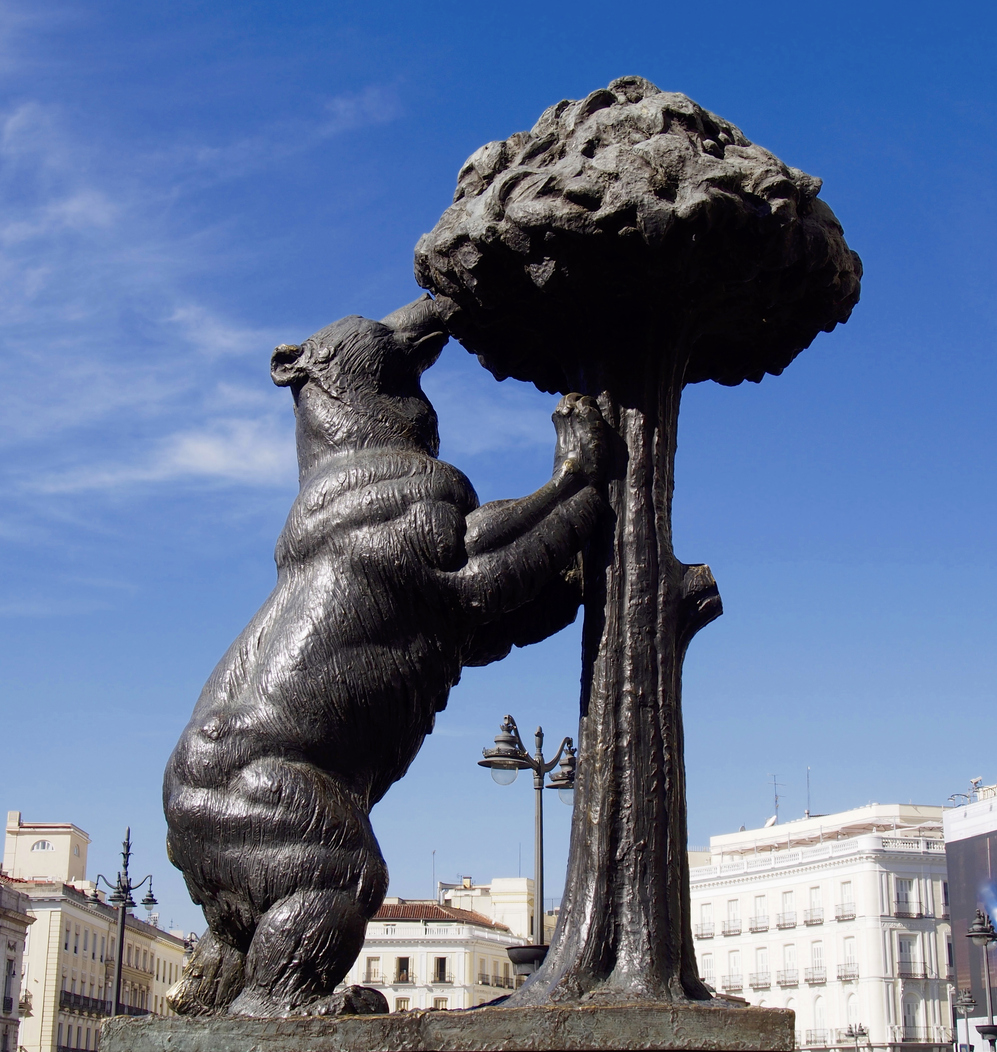
This iconic symbol, El oso y el madroño (The bear and the strawberry tree), can be found in the heart of Madrid’s city center. A 20-ton bronze statue, created by Spanish sculptor Antonio Navarro Santa (1906-1983), depicts a bear eating fruit from the madroño “strawberry tree.” It was erected on January 19, 1967.
Clearly madrones and manzanitas have been capturing the hearts and imaginations of everyone who is fortunate enough to encounter them.
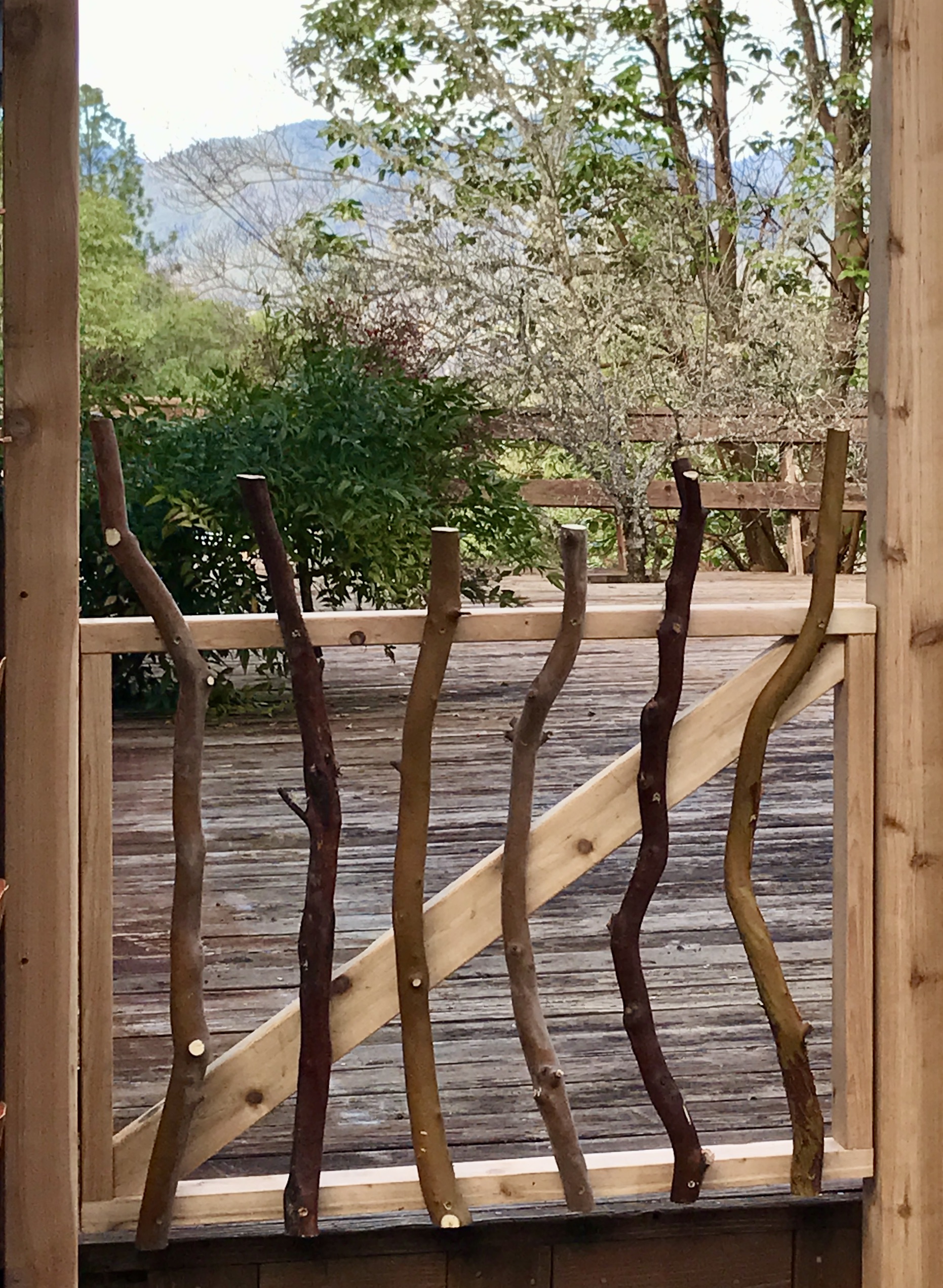
So enchanted by their beauty, we built a gate to our own backyard paradise using madrone and manzanita branches. The three lighter branches are madrone and the darker branches are manzanita. Several madrone trees can also be seen in the background.
Today there are 12 species in the Arbutus (madrone) genus, eight are native to the western coast of North America. Of the 107 manzanita species in the Arctostaphylos genus, 106 grow exclusively along the Pacific coast!
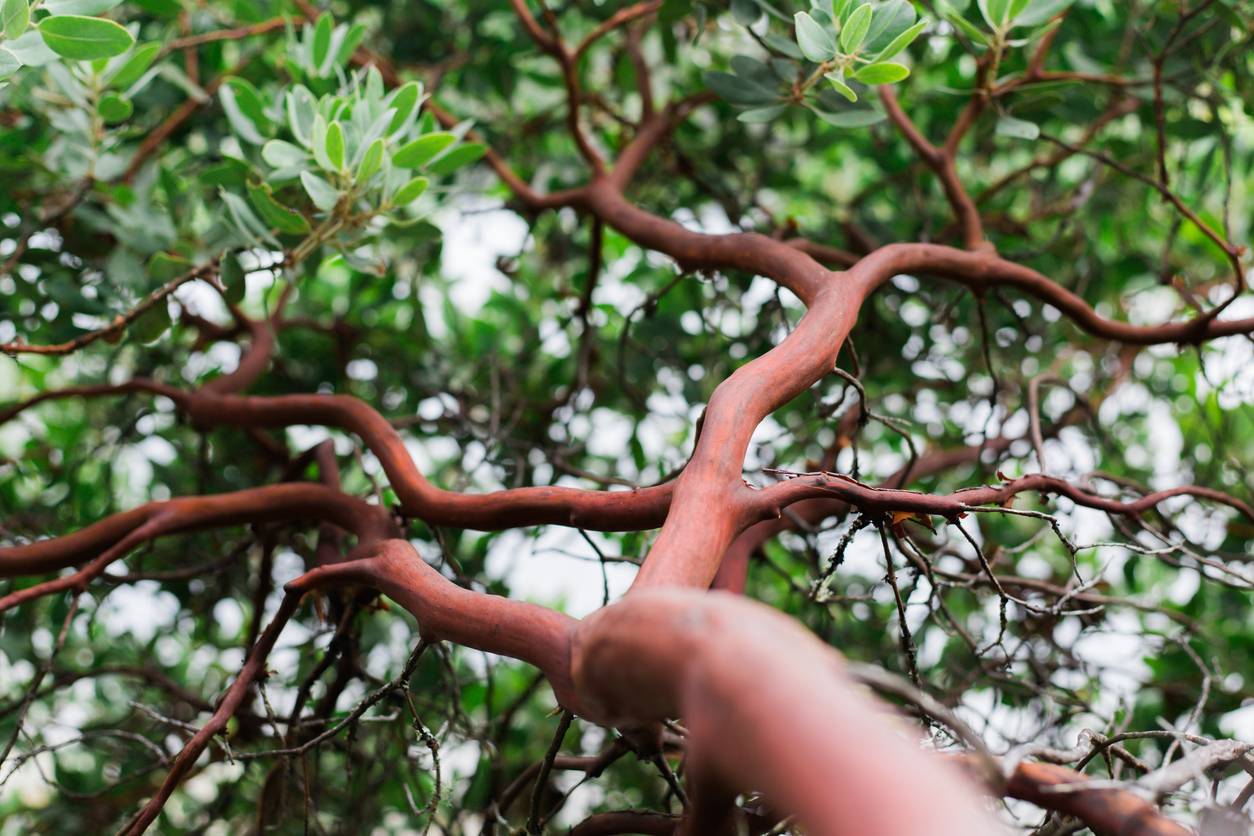
I hope you enjoyed learning about the twists and turns of these fascinating trees.
 Tree Spirit Wisdom