The Winter Solstice is the most sacred time of the year.
In the Northern Hemisphere it occurs when Earth’s North Pole tilts furthest away from the Sun “Sol.” This natural phenomenon creates the longest night of the year before Earth begins to tilt back toward the Sun on the Summer Solstice in June. This long dark night of the “Sol” mirrors the long dark night of the “soul.” This is a time for us to look inward during periods of darkness so we can renew, reclaim and transform our lives.
Before the Solstices were truly understood our ancient ancestors feared that the Sun was dying. They shared stories that tried to make sense of what was happening as they sat around fires hoping the Sun would regain its strength and live again.

Over 10,000 years ago, during the dawn of the agricultural age, these northern people began to notice a stationary star in the center of the night sky. They saw trees as cosmic ladders or poles that could help them record the movements of the sun by day and the stars at night. Some began imagining super natural beings circling this curious star in flying chariots, boats and sleighs as they maintained the orderly cycle of the seasons. Others saw it as a portal to the afterlife, where souls could be reborn.
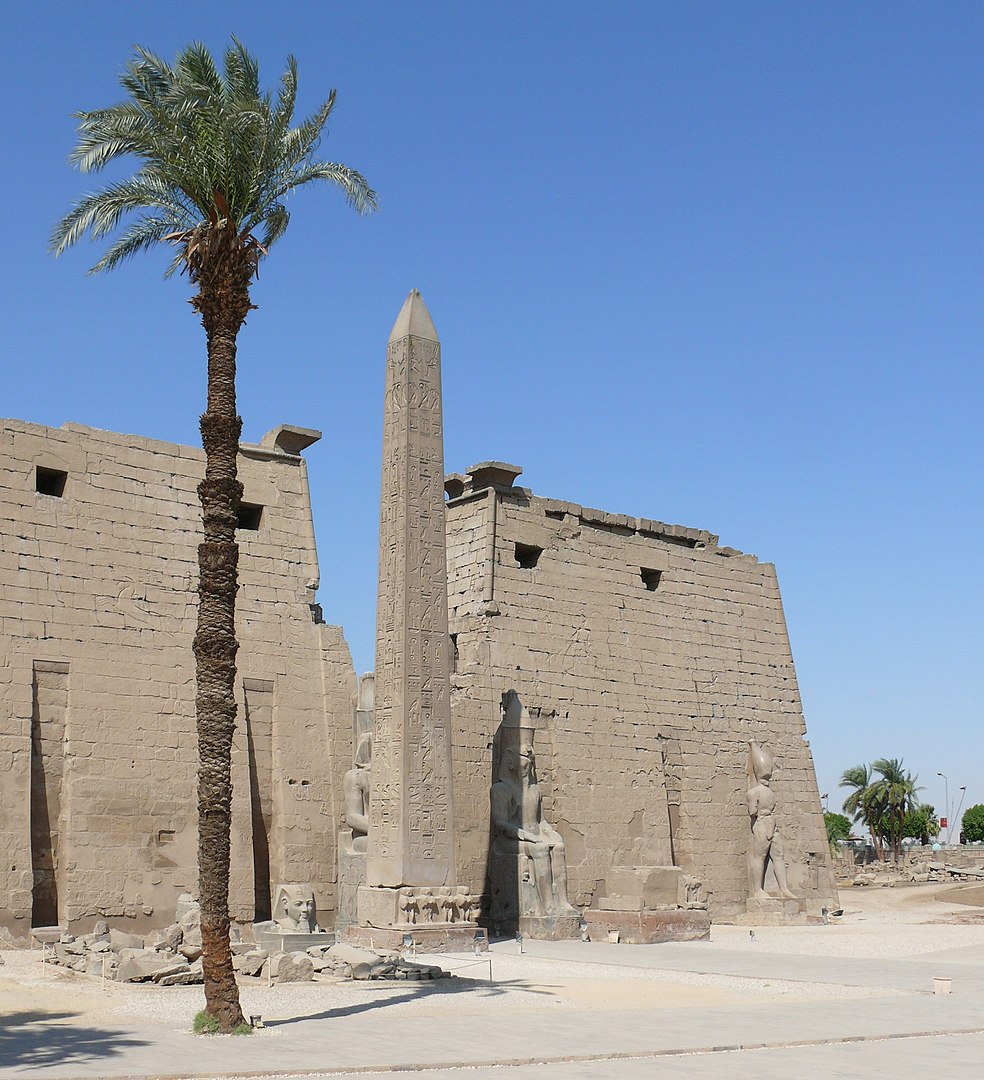
In Ancient Egypt stone obelisks were erected to replicate date palms that pointed to the North Star. They were used to track the yearly cycle of the Sun god RA who was reborn on the Winter Solstice. Obelisks and date palms were also placed near entrances to temples and pyramids to guide a pharaoh’s soul to the afterlife.
In 37CE a 2000 year old Egyptian obelisk was transported from Alexandria to Rome to honor Julius and Augustus Caesar. The Romans celebrated the Winter Solstice with a seven-day feast called Saturnalia in honor of Saturn, their agricultural god who brought back the Sun (Sol) each year. It stood in Nero’s circus where Romans persecuted Jews and Christians for not worshipping their pantheon of nature-based gods.
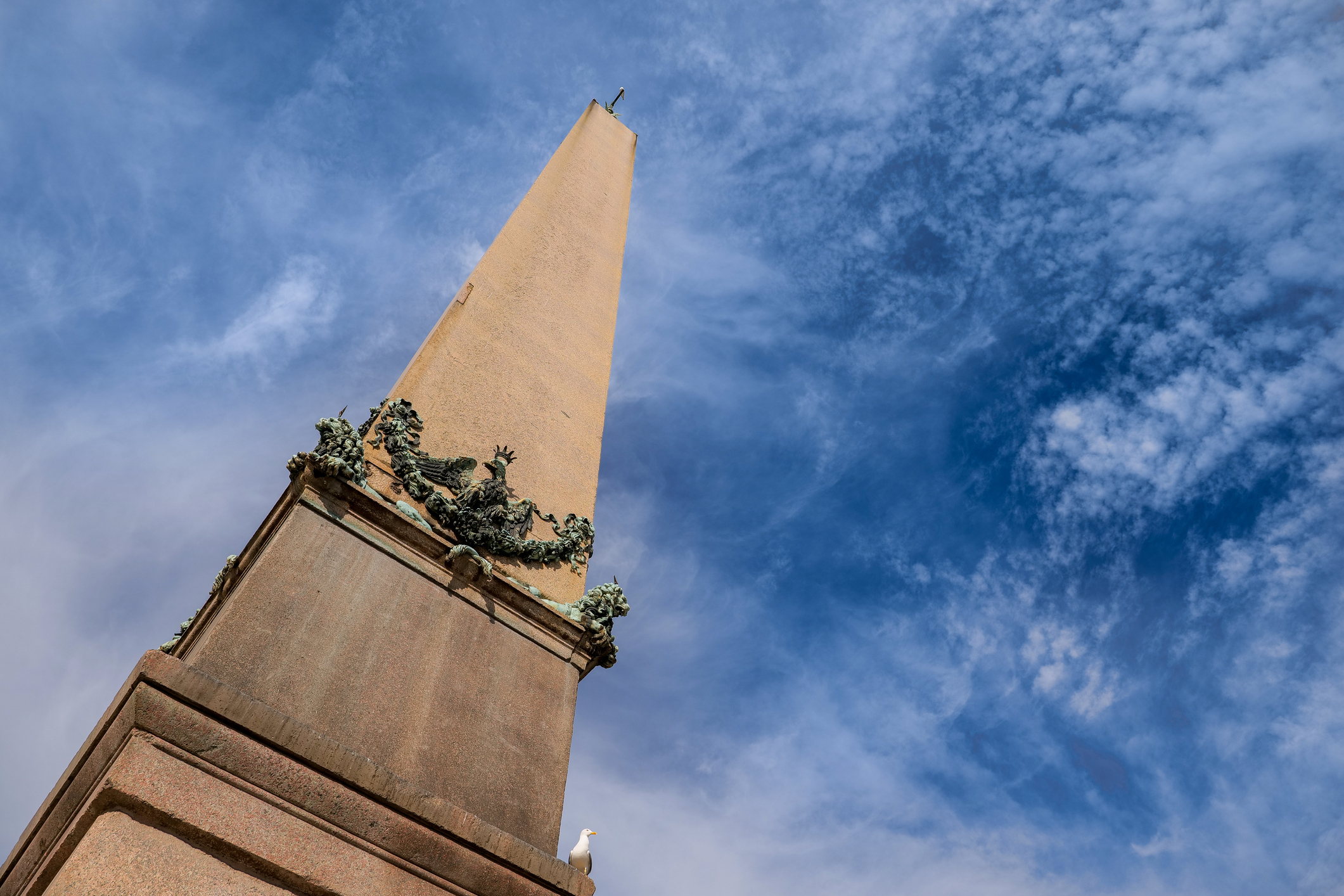
In 337CE Roman Emperor Constantine chose December 25, the nominal date of the Winter Solstice, as the birthdate of Jesus the “Son of God” in place of Sol the “Sun God”. Constantine also ordered the construction of St. Peter’s Basilica, and instructed that it be built around the Egyptian obelisk as a “witness” to Rome’s conversion from Paganism to Christianity. During this tumultuous time a gift-giving Bishop named Nicholas of Myra was imprisoned and released, after his death on December 6, 343 CE he became known as St. Nicholas.
In 1582, the Gregorian calendar was implemented to reflect the true astronomical date of the Winter Solstice, which now fell on December 21. This provided an opportunity for the Catholic Church to separate the nature-based celebration of the Winter Solstice from the Christian celebration of Christmas on December 25.

Today, this 4000 year old obelisk stands in the center of St. Peters Square, functioning as a giant sundial that is aligned with the North Star. At noon on December 21 & 22 its shadow falls on a marble disk furthest from its base to mark the Winter Solstice.
Meanwhile St. Nicholas was slowly transformed into Santa Claus, a gift-giving elf from the North Pole, who circles the Earth in a magical sleigh with eight tiny reindeer.
To learn more you will need to read the rest of the story…but it’s a long one!

Before the creation of time, trees were regarded as wise elders that enabled humans to experience all the realms of existence. Being the tallest living things on Earth, it was only natural that they invited our ancient ancestors to reach for the stars at night and the sun by day.
One of the earliest examples of humans using trees as cosmic connectors can be seen in the Shigir Idol, c. 10,000 BCE. This 17 ft tall statue was carved from a 157-year-old Siberianlarch (Larix sibirica) found in the Ural Mountains of North Western Russia. The Shigir Idol is the oldest known wooden sculpture in the world, making it twice as old as Stonehenge and the Great Pyramids.

Larch are deciduous conifers in the pine family, that drop their needles in winter. Larch can grow to be 148 feet tall. As the dominant trees in the Boreal/Taiga forests of Northern Eurasia and Canada, they reach further north into the polar ice than any other tree on Earth. There are 10-11 species in the Larix genus, including the North American tamarack, Larix laricina and the Siberian Larch, Larix sibirica. Its timber is hard, durable, waterproof and rot resistant.

Larch trees were sacred to the Tungusic speaking people of northern Russia and China. They called it Tuuru, meaning “Cosmic Ladder” or “World Tree.” Tuuru was also seen as the tree that nurtured the “souls” of young shamans until they were ready to be born. The English word “shaman” comes from the Evenki/Tungus root ša, meaning “to know.” Its origins may also come from an earlier Sanskrit word samana, used to describe rishis or “forest yogis” who meditated with trees such as Himalayan cedar, Cedrus deodara to attain samadhi, a heightened state of consciousness.

Drum frames were made of larch, while reindeer skins were stretched over the frame. The face of the drums were often painted with an image of Tuuru (cosmic tree) pointing to the North Star. The circle in the center represents the Sun radiating in all four directions. Images of reindeer indicate they were the “spirit animals” who guided and protected the shamans on their journey. Shaman’s would drum to enter a meditative state and travel through Tuuru to mediate with the spirit world.
The drums of the Finno-Ugaric speaking Sami shaman’s (Noadi) of Norway, Finland and Sweden shared a similar cosmology with the Evenki of Northern Russia. The diamond shaped-symbol in the center represents Beiwe, the Sami Sun-goddess, who rides a circular sleigh made of reindeer antlers. It also radiates in four directions and points to the North Star via the cosmic tree.

For those living near the Arctic circle, the Winter Solstice signaled a time of 24-hours of darkness that lasted for days, weeks and even months. These “polar nights” occur when the Sun doesn’t rise above the horizon, due to Earth’s North Pole pointing the furthest distance from the Sun.

The nomadic people of the Taiga forest throughout Siberia and Scandinavia lived among the reindeer. They saw reindeer as the “Givers of Life.” In North America reindeer are called caribou.

The Trundholm Sun Chariot, discovered in a Denmark bog, dates back to 1400 BCE. It’s a bronze statue of Sunne the sun goddess riding a chariot pulled by a horse. The four-spoked wheels represent the four directions.

Saule the Baltic Sun Goddess, in Latvia and Lithuania, was said to ride a solar chariot pulled by two horned deer. According to legend she would return the Sun on the Winter Solstice and throw pebbles of ancient Baltic amber into chimneys at night as symbols of the Sun’s return.

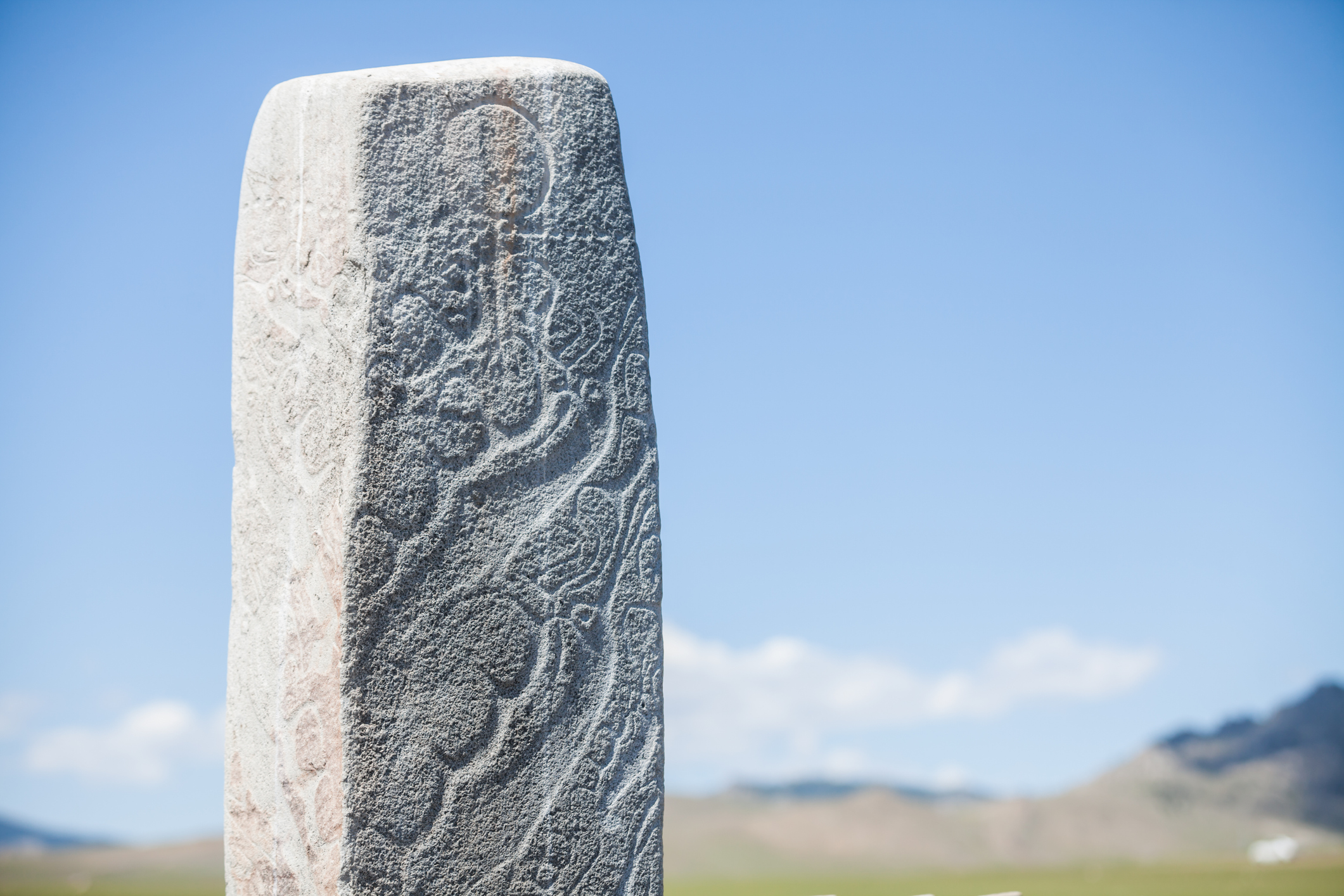
Evidence of this connection between humans and deer/reindeer can be seen in the ceremonial “Deer Stones” scattered throughout Mongolia and Siberia. These stone markers are engraved with images of red deer/reindeer flying upward toward the North Star, they face East toward the rising Sun. This connection between the North Star and the Sun sparked the imagination of people throughout the Northern Hemisphere.
“When mankind began measuring the movements of the planets and the stars, this led to the realization that the cosmos was mathematically ordered. This shifted the focus from animal and plant messengers to the night sky and the ever dying and self-resurrecting moon and the sun.” – Joseph Campbell
As humans shifted from nomadic hunter-gatherers to an agrarian way of life they took more interest in the trees around them. By living in one place they could watch how the Sun created shadows that changed as the days changed.

They also tracked the moon as it transformed from a glowing circle to a crescent before disappearing and reappearing as a crescent in the opposite direction only to become full again. By counting “moons” as a cycle of time, they created the concept of “months.”

At night they also watched the stars and noticed that some stars wandered while others stayed in fixed clusters. Stars were understood to be where their ancestor’s spirits went after death. They honored the wisdom of the stars that watched over them.

They began to notice that trees changed as the amount of sunlight changed. When trees started to bud the Sun was growing in strength and the amount of daylight was equal to night. When the trees were full of leaves the Sun was at its strongest, and the amount of daylight was longer than night. But when the leaves fell the Sun’s strength weakened and the days grew cold and daylight was once again equal to night. By the time the trees were bare the Sun was barely there too, which was frightening. The trees showed them that the circle of life was connected to the Sun’s return year after year. They saw trees as teachers who connected them to the Sun and Stars.

They began turning trees such as larch, pine, birch, alder, ash or oak, into “poles”. These poles were placed in open spaces and honored as the “wisdom keepers” of the Sun. They noticed that the poles shadow would change direction and length as the sun changed. Over the course of twelve moons these shadows began to repeat them selves.
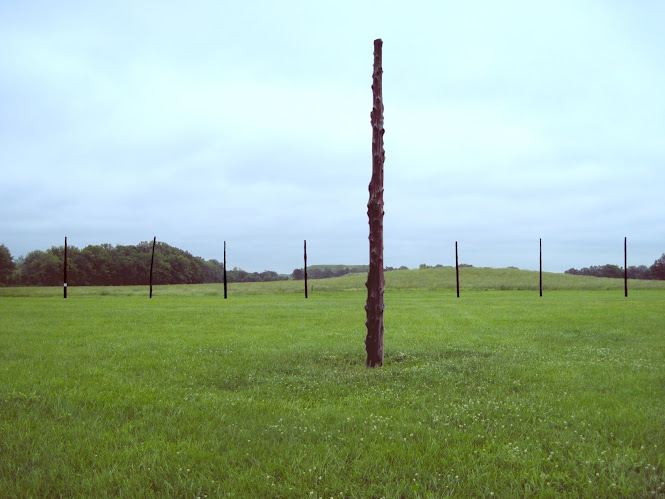
In northern Europe, around 8500 BCE, wood poles were used to build large wooden circles, called henges to record these shadows. The Goseck Henge in Germany dates to 4900 BCE. It consisted of a large outer ditch enclosing a circle of pine poles with a singular pole in the center. The primary entrances marked the sunrise and sunset on the Winter Solstice. These circular tree henges inspired the creation of solar and star calendars.
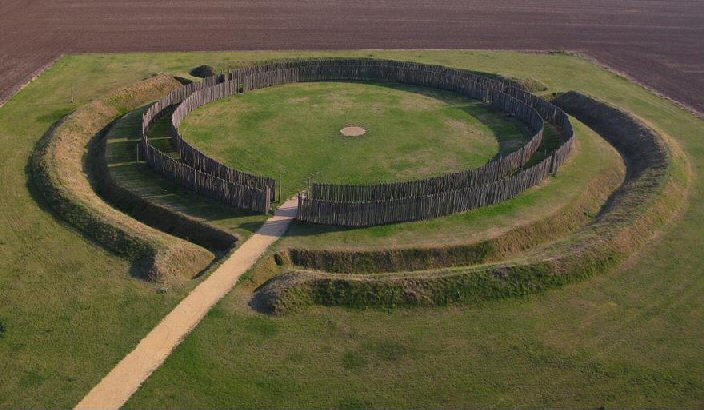
Unfortunately trees, poles and wood henges couldn’t withstand the test of time. Their immense contribution to our understanding of the universe quietly decomposed and returned to Earth. Their legacy is now found in language, myth and architecture, as well as our collective conscious.
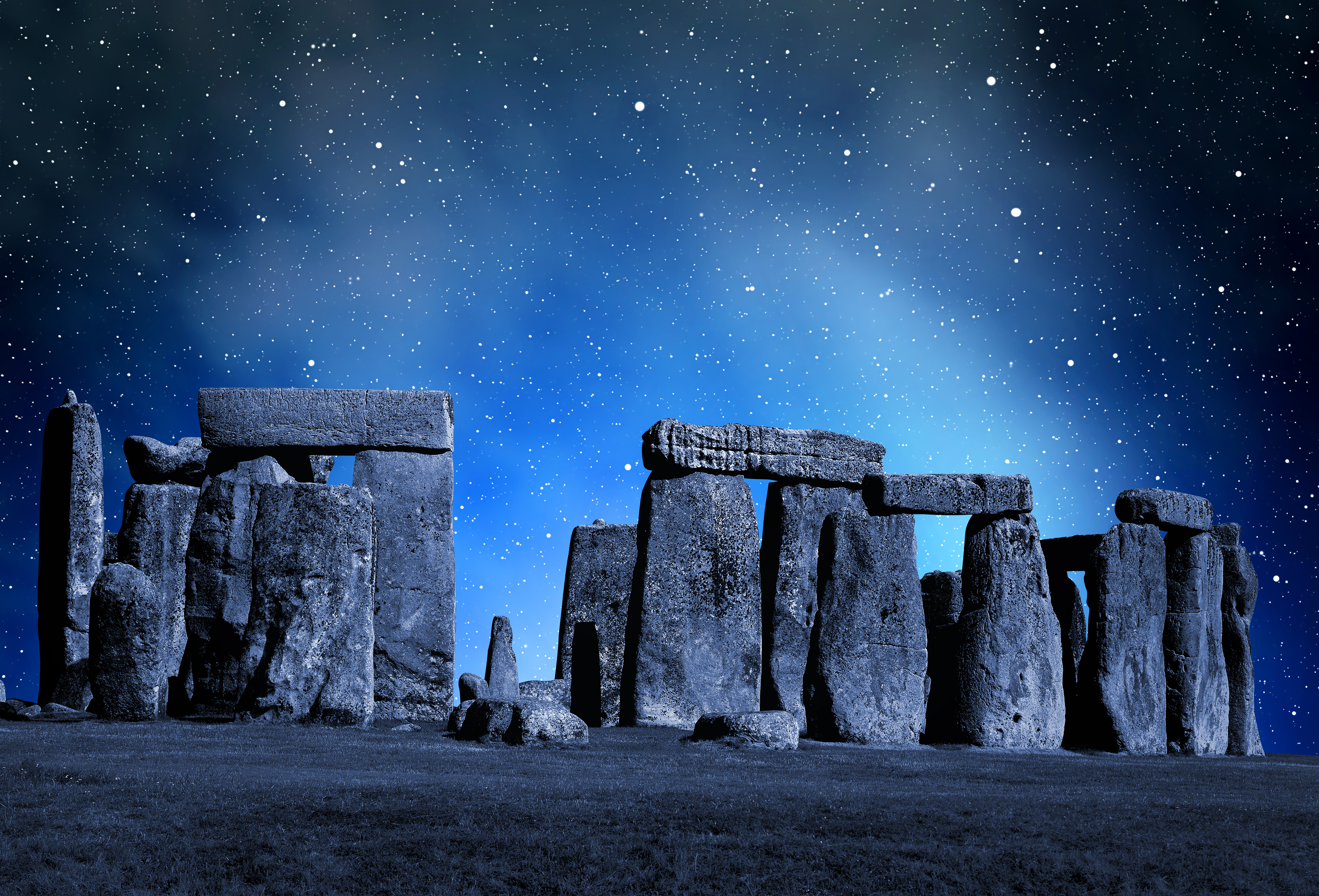
Stonehenge in Wiltshire, England is an example of a previous tree henge that was built with stone around 2500 BCE. It aligns with the Winter Solstice at sunset and the Summer Solstice at sunrise.
When stargazers throughout the Northern Hemisphere noticed a singular star or space in the night sky that other star clusters revolved around they believed it was the center of the universe. They associated the most prominent cluster of fixed stars with dragons, chariots, ploughs and wagons.
In reality, there are six “North Stars” within a ring of North Stars. This is due to Earth’s axial tilt (precession of equinoxes), which takes approximately 26,000 years to complete. Our current North Star is Polaris, meaning “Pole Star.” Polaris will peak in the year 2100. Vega and Thuban were the North Stars of our ancient ancestors.
- Vega – 12,000 BCE – Constellation Lyra (Lyre)
- Thuban – 3000 BCE – Constellation Draco (Dragon)
- Polaris – 2100 CE – Constellation Ursa Minor (Little Bear/Little Dipper)
- Alrai – 4000 CE – Constellation Cepheus (King)
- Alderamin – 7500 CE – Constellation Cepheus (King)
- Denab – 10,000 CE – Constellation Cygnus (Swan)
- Vega – 14,000 CE – Constellation Lyra (Lyre)
Around 3500 BCE the Sumerians, (present day Iraq), began to worship supernatural sky gods and goddesses. They saw Earth as a flat circle of rock and ground that floated upon water. It was covered in a protective dome filled with stars. Beyond the dome was the chaotic and primordial sea.

The chief ruler of the Sumerian gods was Enlil, lord of wind, “as the most high” who ruled the highest sky. Enlil’s temple in Nippur (Iraq) was named Ekur, the “Mountain House”. Ekur was thought to be tethered to the North Star as Enlil rode the “wagon” (Big Dipper) around the sun. Enlil was held in such high esteem, that his legacy continued on in the form of El and Elohim in the Old Testament. His father Anu, the sky father, ruled the middle sky, while his brother Enki, lord of water, ruled the lower sky. These three “sky’s” were seen as layers that arched above the flat surface of Earth. The North Star was located in the center of the dome at the highest peak. The lower sky provided an entrance to the lower world of Abzu, the abyss of water below earth’s surface.

Based on this cosmology, Sumerian and Babylonian astronomers were the first to record the orbits of the sun, moon, planets and stars in cuneiform onto clay tablets. They observed the stars from the perspective of Earth being the center of the universe, the Sun moved through the stars around them. This inspired a 360-day lunisolar calendar with twelve 30-day “moons” in one solar year. They added an extra month every few years to make up the difference. By measuring the sun’s path, they defined a circle as 360 degrees and divided this ring of stars into twelve 30-degree sections. This formed the foundation of the Zodiac, “Circle of Animals”. Their base 60 (sexagesimal) numeral system is how we measure time with 60 minutes in one hour and 60 seconds in one minute.

The Sumerians also believed that date palms, Phoenix dactylifera, were the first trees on Earth. They were recorded to be the first tree cultivated through hand pollination. Since only female date palms bear fruit, the gathering of pollen from male date palms was necessary. One male date palm could fertilize one-hundred female date palms.
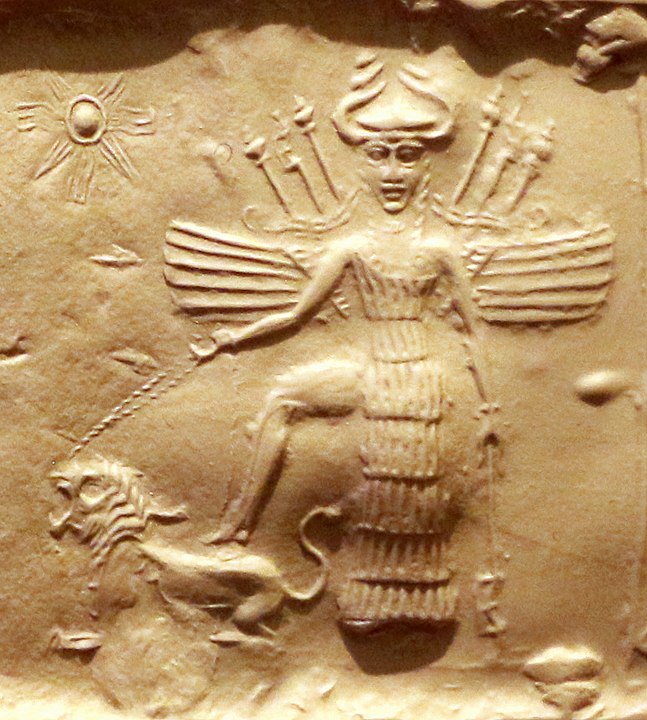
Inanna, the warrior goddess of fertility, was seen as the embodiment of female date palms. She was also associated with the planet Venus, the archetype of the sacred feminine. Her twin brother was the Sun, Utu/Shamash, her father was Nanna, the Moon.
The date palm was also the sacred tree of Ur (southern Iraq), the largest city in the world around 2000 BCE. Ur was also the legendary home of Abraham, the “father” of Judaism, Christianity and Islam. He and his caravan shared the stories of their homeland as they traveled from Sumer (Iraq), through Syria and into Egypt before settling in the land of Canaan (Lebanon, Jordon, Palestine and Israel).
Date palms grew throughout the Middle East and Egypt. They were a welcome site in the desert for they indicated the presence of water in an oasis, “dwelling place.”
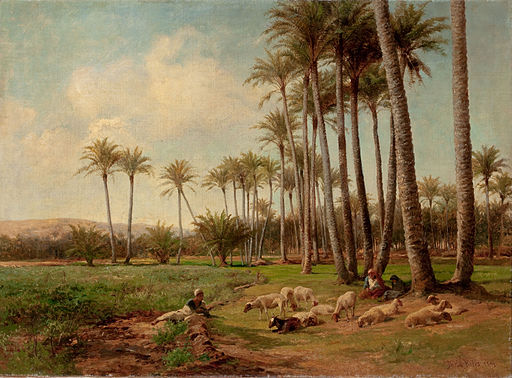
Around 3100 BCE, Egyptian rulers began to believe that their soul (ba) and body (ka) could be reborn, just as the Sun (Ra) is reborn on the Winter Solstice. They were also inspired by date palms that could reach up to the stars.


They believed that the portal to the afterlife existed between two stars that circled the North Star in the center of the night sky. They named these stars “the indestructibles”. Today we known them as Kochab, (Little Dipper/Ursa Minor) and Mizar, (Big Dipper/Ursa Major). At the time, Thuban was the nearest North Star, located in the constellation of Draco (Dragon).

Around 2600 BCE Egyptians began constructing giant obelisks to replace date palms, as more permanent “poles/posts”. These stone obelisks were erected next to funerary temples and pyramids so they could guide souls to the afterlife. They were made exclusively in the city of Iunu/Heliopolis (City of Pillars/City of the Sun) from solid granite mined in Aswan.

The only surviving obelisk in Heliopolis/Cairo, Egypt.
The Egyptian’s reverence for date palms inspired the genus name Phoenix, based on the mythical Egyptian sun-bird known as Bennu. The species name dactylifera comes from the Greek words daktylos (digit) and fero (I bear) because dates resembled fingers or “digits”. Daktylonomy is the name of the Egyptian finger counting system. It’s the basis of their 10 (decimal) numeral system. A finger or “digit” was a standard unit of measurement, which equaled about one inch. A “palm” was the width of four fingers or 4 inches.

This relationship between the Sun and date palms inspired the Egyptian creation myth of Heliopolis.
Atum (creator god), emerged from the watery world of Nu (Nile River) to release his “ba” (soul) in the form of the Bennu (date palm/sun-bird). The Bennu (date palm) separated the daytime sky from the watery world of Nu. At sunset Ra (sun) disappeared into the darkness of night, leaving the Bennu bird (date-palm fronds) to rest on the Benben (sacred mound of dirt). The Bennu (date palm) grew on the Benben (mound of dirt) during the night. When Ra (sun) rose the next morning Atum (creator god) saw that the Bennu (date palm) had successfully separated the sky from earth so he could begin the process of co-creating life as Atum-Ra.

The four-sided pyramidal capstones placed on top of obelisks and pyramids were named “Benben”, from the Egyptian verb wbn, “to rise shining”. The Benben was seen as the physical embodiment of the Bennu (date palm/sun-bird) that held the “ba” or soul of Atum-Ra who accompanied them in the afterlife.
Later (2040 – 1782 BCE) in the city of Thebes/Luxor the Egyptians began to worship Amun, god of air and wind, as the invisible force of creation. There Amun was paired with Ra the sun god as Amun-Ra. Amun-Ra was depicted as a falcon crowned with a solar disk.

The Temple of Karnak was dedicated to Amun-Ra, (c. 1290 – 1224 BCE). It was constructed when Thebes was the capital of a unified Egypt. The temple is aligned with the sun so that on the Winter Solstice the sun shines on the shrine of Amun-Ra.
This concept of wind/air allowing trees/poles to grow and separate earth/water from sky/stars for life to begin is a common theme throughout the world.
In ancient Taoist and Chinese belief the primordial universe was named Wuji, based on wu (nothing) and ji (pole). The Taiji (supreme pole/wind) separated Wuji (no pole) to divide and create the harmony of opposing forces known as Yin (passive) and Yang (active). The Taiji is directly related to the Earth’s axis that runs through the celestial north and south poles. This dynamic relationship creates balance in the universe known as the eternal life-force energy of Chi.

In Chinese and Taoist mythology, Huang Di was seen as the first Emperor, c. 2500 BCE. In death he ascended to the North Star riding a dragon, inspired by the constellation Draco. In his afterlife he became the Yellow Emperor (Sun) who rode a wagon (Big Dipper) around the North Star. As the Sun, he had four faces to watch over the land in all directions. The first temples were built on top of mountains to be close to the North Star.
“He who rules by moral force is like the pole-star, which remains in its place while all the lesser stars do homage to it.” – Confucius (551 – 479 BCE)
In Hindu mythology, c. 1500 BCE, Surya the Sun god rode a solar chariot pulled by seven horses around Mount Meru. In Sanskrit meru means “high.” The top of Mt. Meru represents the connection to the North Star in the center of the universe where the devas live. The Sun, Moon, Stars and planets all rotate around Mt. Meru, which is seen as the pole or Axis Mundi of Earth.

The concept of Mount Meru influenced the cosmology and architecture in Buddhism, Jainism and Taoism. Their temples were built to represent Mt. Meru on Earth. The Shikara meaning “mountain peak” sits atop the temple with a finial that connects Earth to the North Star in the center of the Universe.
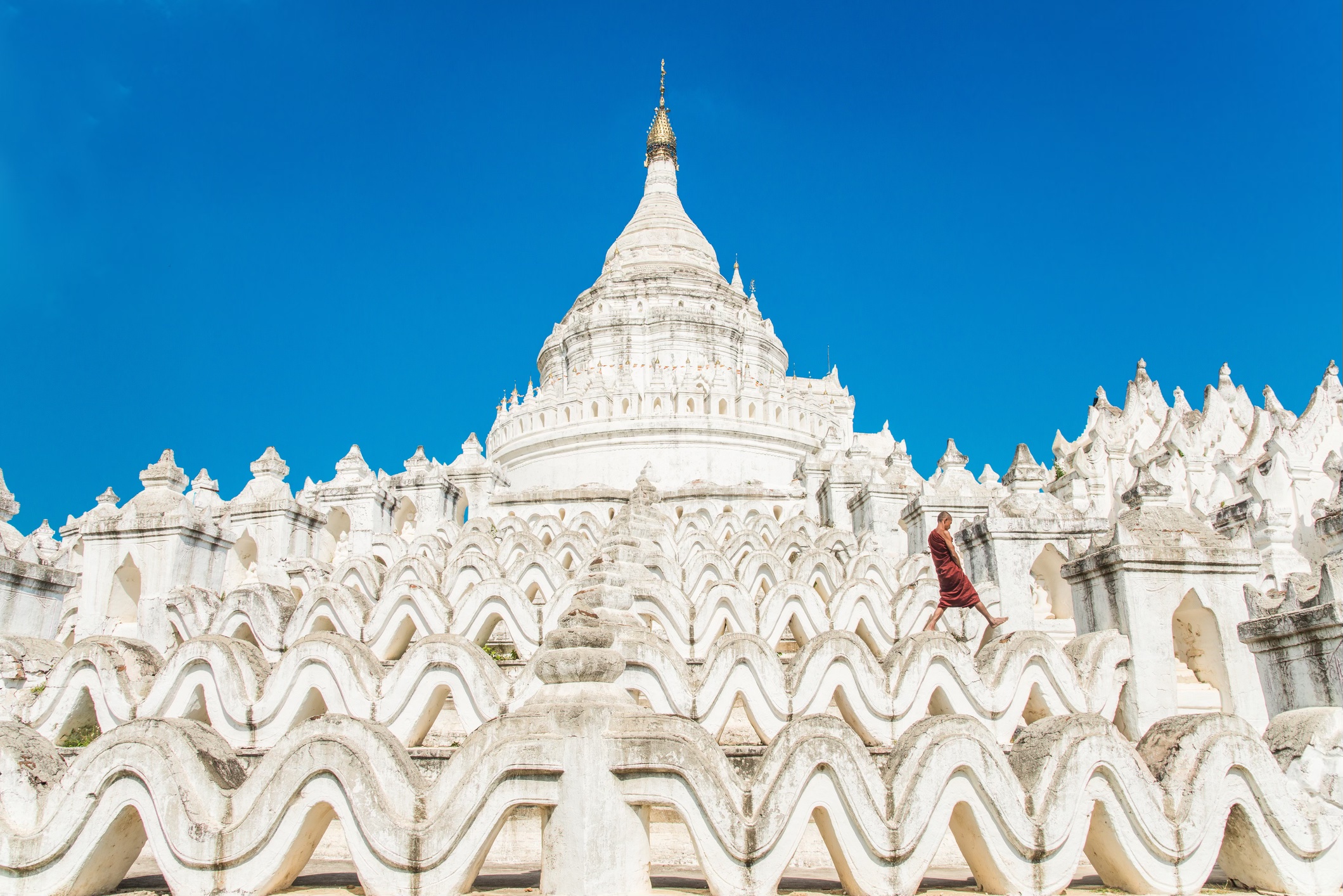
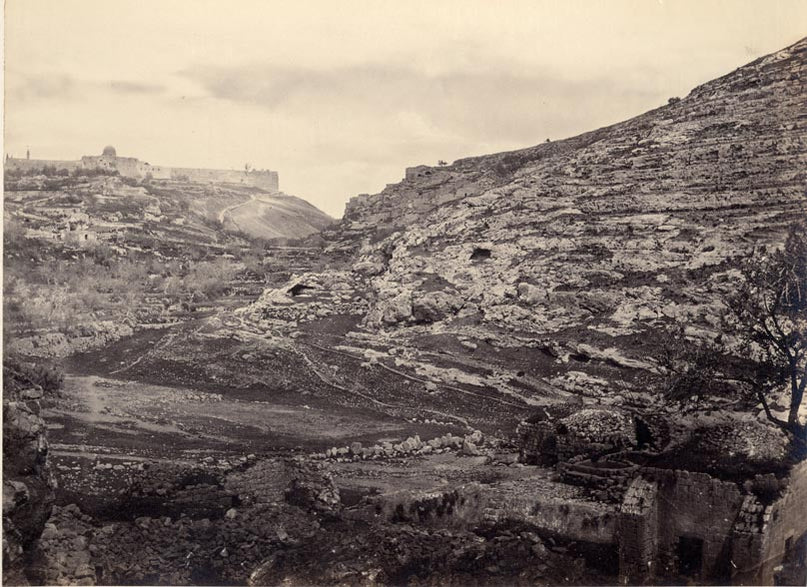
Like Mount Meru, Mount Moriah has been a sacred temple mount for the past 3000 years. Today it is the holy site for Judaism, Christianity and Islam.
Around 800 BCE Greek poets such as Homer and Hesiod wrote epic stories of gods and goddesses who gave birth to the Titans and Olympians. In Greek mythology Gaia (Earth) birthed herself from the chaotic void. She created and mated with Uranus (Sky) to birth the Titans. Uranus, fearing the power of his children, imprisoned them within earth. This angered Gaia, who asked their son Cronus to castrate his father and release his siblings. Cronus became King of the Titans and the Father of Time who ruled over the mythological “Golden Age” of Greece.

There were four Titans who held up the sky and fathered the Sun, Moon, Stars, etc.
- Coeus (North Pole) – Titan of the Celestial Axis – Father of the Zodiac.
- Hyperion (East Pole) – Titan of Light and Intellect – Father of the Sun, Moon and Dawn.
- Crius (South Pole) – Titan of Constellations – Father of Stars and Winds.
- Iapetus (West Pole) – Titan of Mortality – Father of Fire and Dusk.
Helios, son of Hyperion, was the Greek Sun god who rode a chariot with four horses (quadriga) that pulled the sun from East to West each day. He wore a halo or “ring of light” around his head.

This “Golden Age” ended when Cronus began swallowing his children whole, in fear of being overthrown like his father Uranus. Cronus’s sister/wife Rhea wished to free her children so she hid their youngest son Zeus until he was old enough to overthrow Cronus and release his siblings. Zeus as King of the Olympians overthrew Cronus the King of the Titans in a ten-year war known as the Titanomachy to establish a new divine order. Zeus became the King of the Gods who ruled from Mount Olympus.

The actual “Golden Age” of Greece, better known as Classical Period went into decline around 404 BCE and ended with the death of Alexander the Great in 323 BCE. This marked the beginning of the Hellenistic Period when Greek and Roman cultures merged along with Indian and Egyptian influences. The Greek gods Cronus (agriculture) and Chronos (time) were assimilated with the more jovial Roman god Saturn.

Saturn, the Roman god of agriculture was celebrated during the “Golden Age” of abundance and peace before 500 BCE. Saturn was also seen as the god of time, wealth, dissolution and renewal. As the “Bringer of the Sun” his harvest festival named Saturnalia was celebrated around the time of the Winter Solstice.

By 133 BCE the festival of Saturnalia was extended to seven days (December 17-24) leading up to the eve of Winter Solstice. Saturnalia was celebrated with feasting, lighting candles, gift-giving and games. The Romans associated holly as the sacred plant of Saturn, its red berries and evergreen leaves symbolized the continuation of the growing season and the undying Sun. Wreaths and boughs of holly were used to decorate homes and public spaces.

In Celtic, Germanic and Norse mythology, holly was also sacred to the “Mother Goddesses” Holde, Jord, Fjorgyn, Freya and Frigg. The Eve of Winter Solstice was known as Modranicht or “Mother’s Night.” It was a time of honoring all the mothers who labored to birth the sun back into the world by spinning the Wheel of Fate. Altars were adorned with candles, food, holly and evergreen boughs.
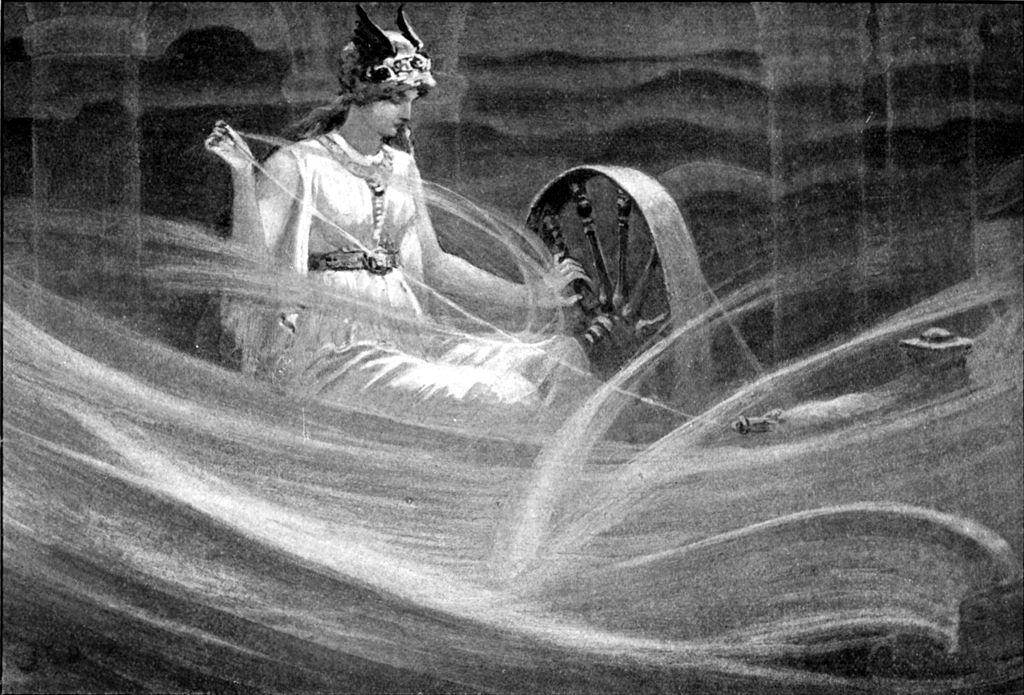
Winter Solstice was the feast day of Frau Holda/Holle who rode a wagon (Big Dipper) around the North Star to bring back the Sun. During her yearly journey around the Sun she would transform between maiden, mother and crone.
On Winter Solstice the Druids would harvest mistletoe from the barren branches of oak trees. They believed that the mistletoe’s white berries captured the Sun’s purest essence, from which they made medicinal elixirs. They dressed in white robes and carefully laid white cloth on the ground so the mistletoe would remain “pure”.
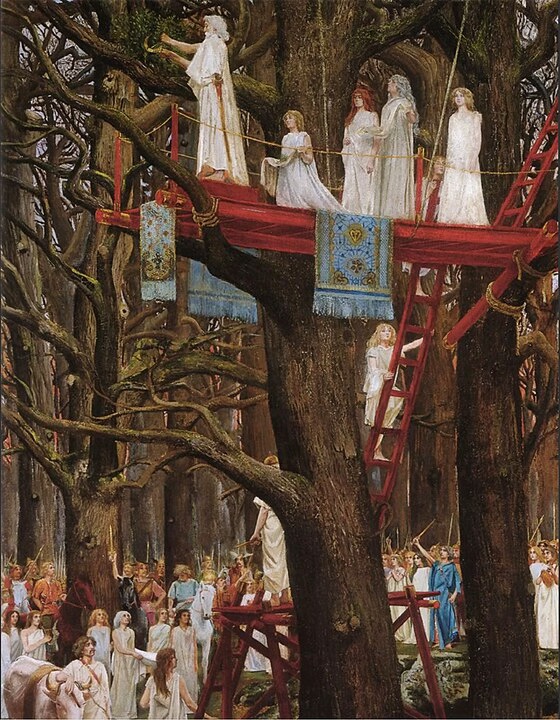
Oak trees were very sacred to the Druids. The word Druid means “oak wise” or “oak seer” based on the idea that Druids could travel through the door of an oak. Similar to shamanic cosmology, they would gather insights from the underworld, the middle world and the upper world.
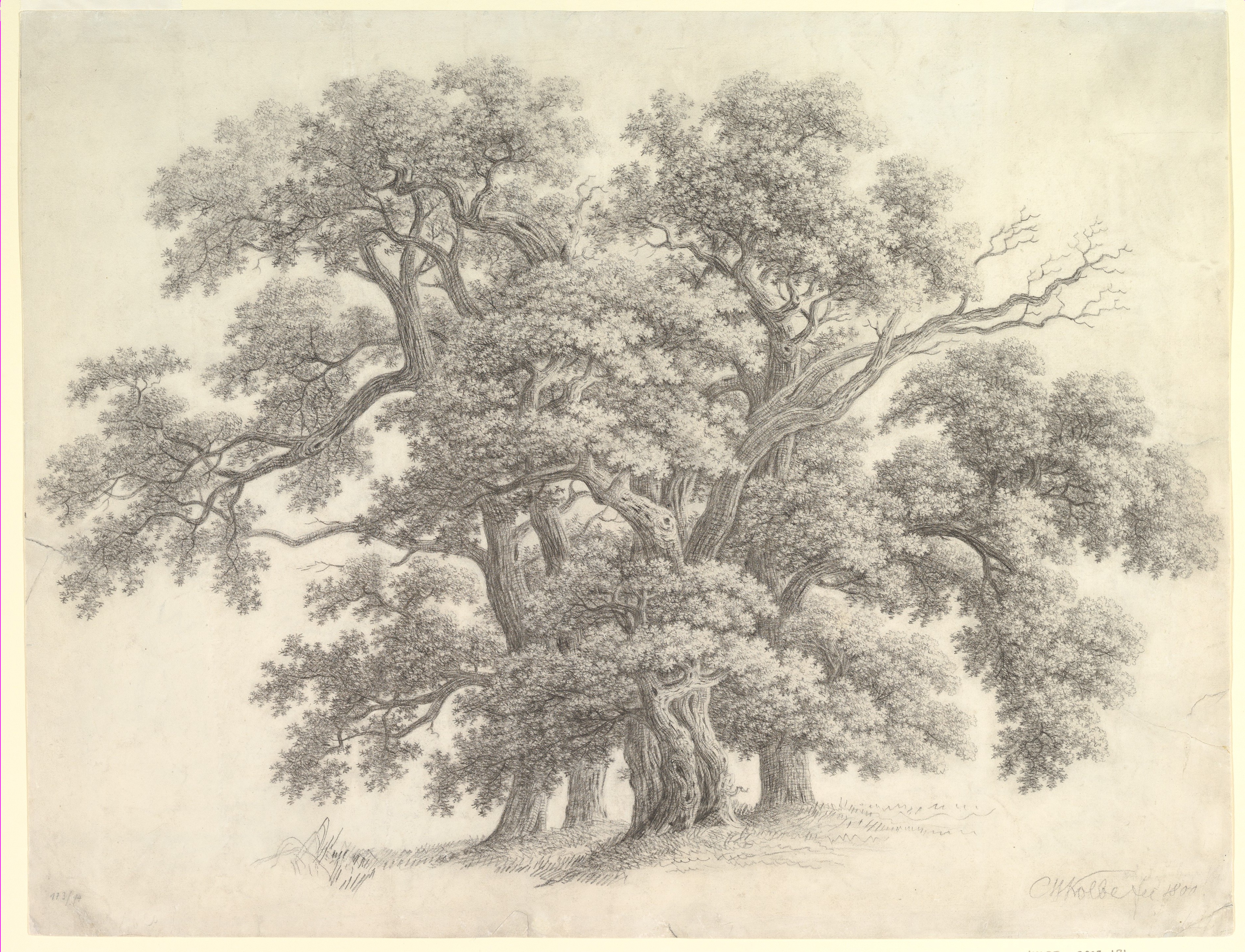
Oaks were also sacred to the Germanic “Father Gods” Woden, Odin and Thor. Before the Winter Solstice, oak trees were cut into 12 yule logs. For twelve days, beginning on the Winter Solstice, they would add one yule log to the fire. This was thought to bring good fortune for the twelve months to come. The twelfth log was set aside and decorated with holly to bring good fortune for the following year.

Jol (Yule) was a twelve-day midwinter festival in the Germanic/Norse cultures of Northern Europe and Scandinavia. Yule was a time of honoring the death and rebirth of the agricultural year with feasting, drinking, storytelling and gift-giving.
Odin, the Norse Sky Father, is based on the older Germanic god Woden. During Yule, Odin rode Sleipnir, an eight-legged horse, across the night sky during the “Wild Hunt,” to chase out the darkness.
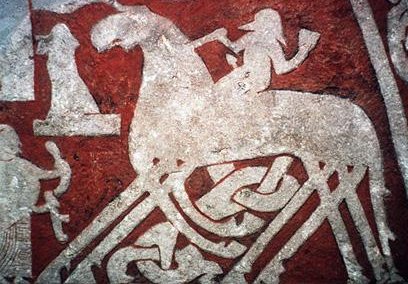
Odin’s son Thor was the agricultural god of rain, thunder and lightning. Thor brought back the Sun on the Winter Solstice. He rode through the sky in a wagon drawn by two magical goats, named Tanngrisnir and Tanngnjóstr, who could grind wheat with their teeth. This was significant because the last sheaths of grain needed to ground before Winter Solstice. According to legend Thor would offer his goats for a feast on the Eve of Winter Solstice, only to see them reborn in the morning.

These “old” stories began to disappear after the Roman general Julius Caesar (b.100 – d. 44 BCE) marched into Northern Europe and Britain during the Gallic wars. The first documented account of the Celtic and Germanic people comes from his writings around 55 BCE, which is when the Celts and Druids began to escape into England, Ireland and Scotland.
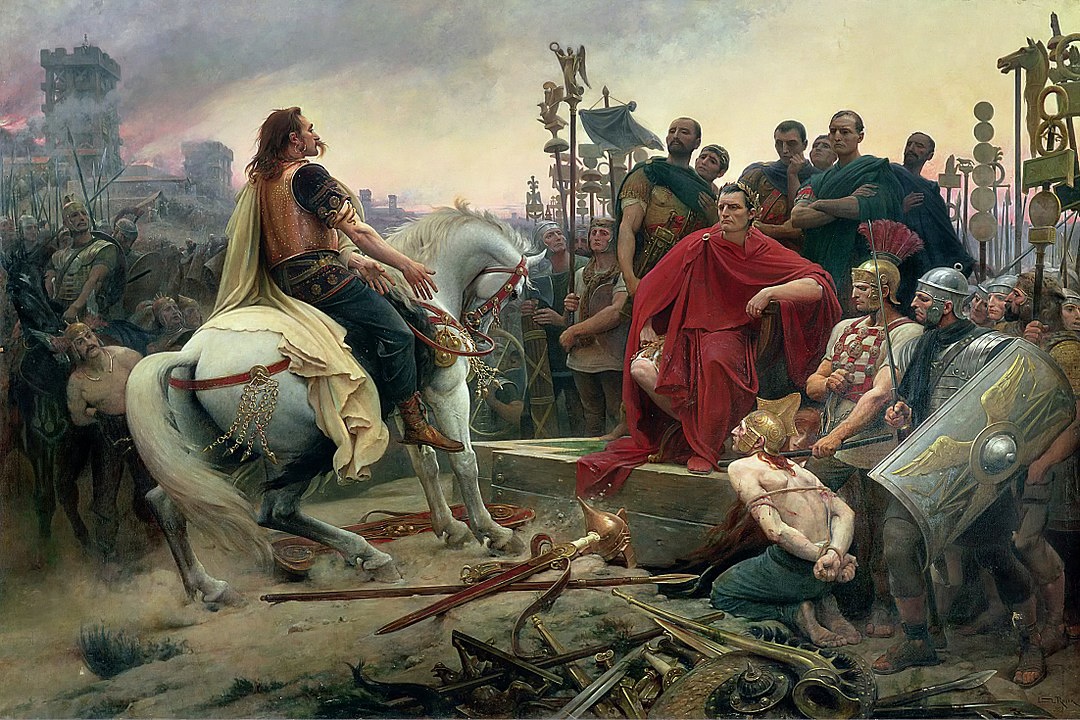
In 45 BCE, Julius Caesar introduced the Julian Calendar, a 365 day solar calendar that aligned with the Solstice’s and Equinox’s. On March 15, 44 BCE was assassinated. Before his death he named his nephew Gaius Octavius Thurinus as his sole heir, giving him the title Gaius Julius Caesar. To honor his uncle, Gaius had a 2000 year old unmarked obelisk moved from Heliopolis to the Julian Forum in Alexandria, Egypt between 30-28 BCE. Gaius became known as Augustus Caesar, the first true Emperor of Rome in 27 BCE. Since Julius Caesar was the first Roman to attain “divine” status, Augustus was seen as the “Divine son of the Divine Julius, who was chosen by Apollo (god of sunlight) to usher in a new “Golden Age”.
During the reign of Augustus Caesar, another “divine child of light” named Jesus, was born in the Roman province of Judea.

The gospels of Matthew and Luke are the only gospels that mention the story of Jesus’s birth, but they offer very different versions. The Gospel of Matthew tells of an Angel that appeared to Joseph and that three Magi followed a star to Bethlehem to give the baby Jesus gifts of gold, frankincense and myrrh. The Gospel of Luke tells of the archangel Gabriel appearing to Mary. Mary and Joseph leave Nazareth and travel to Bethlehem. Shepherds are summoned by the angels to see the baby Jesus.

Jesus went on to be a teacher and healer who tried to help those who were less fortunate. After his death in Jerusalem, around 33 CE, his followers called him “Christ”, based on the Greek word “Christos” meaning the “anointed one”. They became known as “Christians” who traveled to the “four corners” to spread his teachings.
In 37 CE, four years after Jesus’s death the Roman Emperor Caligula (r. 31 – 41 CE) had the Julian Forum in Alexandria dismantled and moved the obelisk to Rome, on land he had inherited from his mother. He wanted this 84′ granite obelisk to stand in the center of his private Circus (circle) for chariot races, which became known as Nero’s Circus.
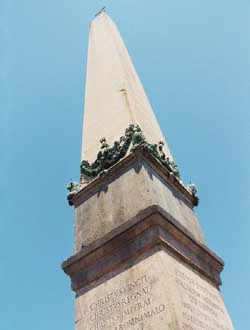
Caligula named it “Caesar’s Needle” and had the base engraved in tribute with the following words: “Divine Caesar Augustus, son of the Divine Julius Caesar, and Tiberius son of the Divine Augustus.”
In 275 the Roman Emperor Aurelian unified the Roman gods into one as Sol Invictus, “The Invincible Sun.” Sol Invictus was celebrated on December 25, the known date of the Winter Solstice as Dies Natalis Solis Invicti, the “Birthday of the Invincible Sun”. This “birth day” of the Sun followed the seven-day feast of Saturnalia.

During this same time a baby named Nicholas (b. 270 – d. 343) was born in the seaport city of Patara, Lycia in Anatolia (Turkey) to wealthy Greek Christians. Nicholas’s parents died when he was young. some believe that he lived with his uncle, the Bishop of Myra. After his uncle’s death Nicholas became the Bishop of Myra, commonly known as Nicholas of Myra. As a Bishop he was imprisoned by the Romans during a time when Romans persecuted Christians and Jews for not worshipping their gods such as Saturn, Jupiter, Sol etc.. Nicholas was released in 313 during the rule of Roman Emperor Constantine the Great.

Emperor Constantine (r. 306-337 CE) stopped the persecution of Christians after receiving a symbolic vision of Jesus. Since no one knew exactly when Jesus was born, Constantine decided to place Jesus’s birthday on the day they celebrated the Winter Solstice, which was December 25 in 337. He declared that the celebration of the Roman “Sun god” Sol Invictus be changed to celebrate the birth of Jesus as the “Son of God”. Images of Jesus now had the same “halo” around his head, just like the Sun gods of Apollo, Helios and Sol before him.

Constantine also established the seven-day week in the Julian calendar. He designated Sunday as the seventh day of rest. The seven days of the week were named for the seven planetary gods of Rome and their Greek counterparts. As Christianity spread throughout Europe these Roman gods were associated with their Germanic/Norse counterparts and translated to English.
- Sunday – “Sun’s day” – German Sunne, Roman Sol, Greek Helios.
- Monday – “Moon’s day” – German Mani, Roman Luna, Greek Selene.
- Tuesday – “Tyr’s day” – German Tiwaz, Roman Mars, Greek Ares.
- Wednesday – “Woden’s day” – German Woden, Roman Mercury, Greek Hermes.
- Thursday – “Thor’s day” – German Thor, Roman Jupiter, Greek Zeus.
- Friday – “Freya’s day” – German Frigg, Roman Venus, Greek Aphrodite.
- Saturday – “Saturn’s day” – Roman Saturn, Greek Cronus.
Constantine had numerous churches built, including St. Peter’s Basilica in Rome, which is believed to be built over the grave of St.Peter who died in Nero’s Circus near “Caesar’s Obelisk”. For this reason Constantine ordered that the obelisk stay in its original place as a “witness”.

The Apse in the old St. Peters Basilica featured a fascinating mosaic of the apostles St. Peter and Paul standing next to Jesus on a throne. Two date palms appear next to them as symbols of victory.


Beneath them are a row of twelve lambs with trees symbolizing the twelve Apostles. The two trees closest to the center are date palms with circular mosaics of a phoenix bird sitting in the branches. Only two small pieces of the entire original mosaic survived, one is the Phoenix wearing a halo.
In 520, Nicholas of Myra became known as Saint Nicholas. He was celebrated on December 6, his “Feast Day” that commemorates the day he died. St. Nicholas was seen as a “wonderworker” and the benevolent “gift-giving” patron of sailors, children and toymakers etc. His story lifted the spirits of young and old alike.
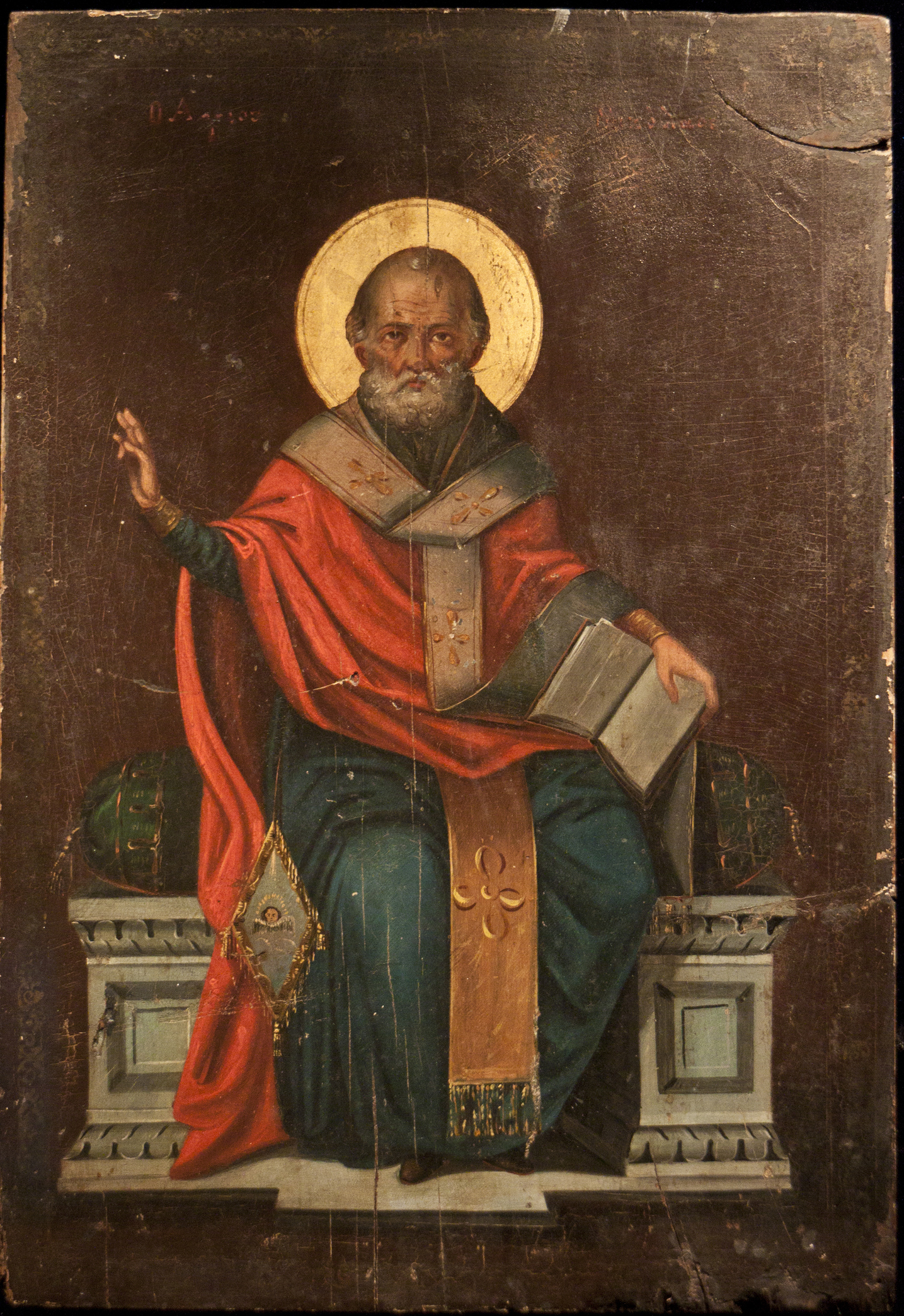
In 567, the Council of Tours officially established the “Holy Season” of Christmas.
- Advent meaning “arrival,” marked the beginning of a four-week period of fasting for Catholic monks, it ended on the Eve of December 24. The first Sunday of Advent marked the official beginning of the religious calendar. Advent replaced the ancient Roman festival of Saturnalia.
- Christ’s Mass was celebrated on December 25, the accepted day of the Winter Solstice.
- Epiphany meaning “to reveal,” was designated as January 6, to mark the day when baby Jesus was blessed by the three Magi. The Eve of January 5 is considered the “Twelfth Night,” which marked the end of the “Twelve Days of Christmas.” Epiphany replaced the Germanic/Norse Yuletide Season.
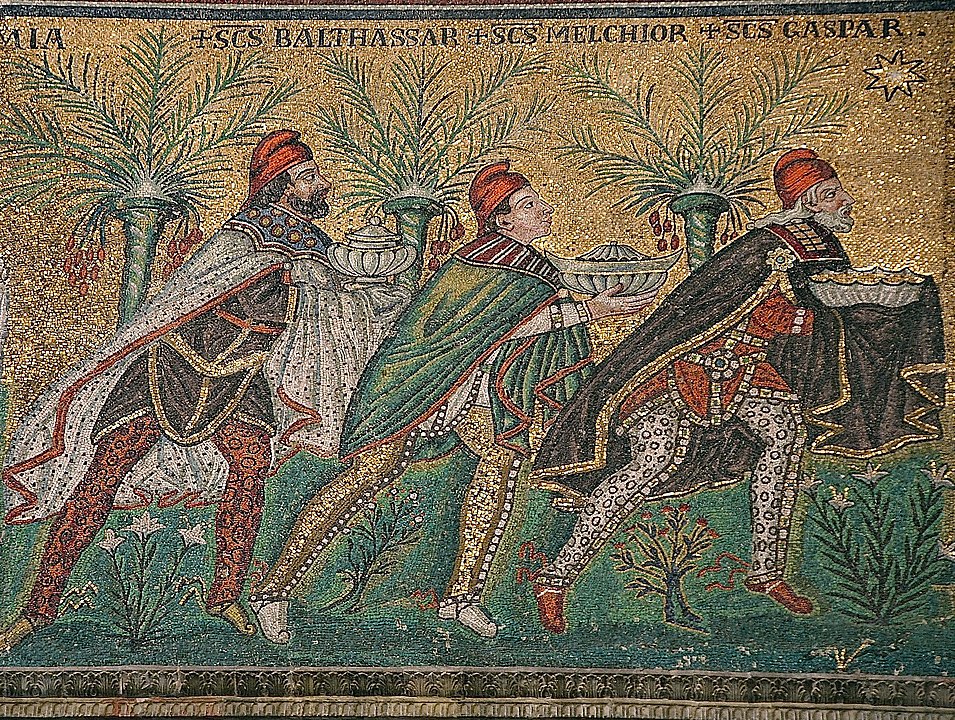
By 700 CE the majority of European countries had converted to Christianity. The main holdouts were the Germanic Saxons who lived east of the Rhine and North of the Danube. They honored trees as spiritual beings. Their “Great Pillar” known as Irminsul, represented the “World Tree”. In 772 Charlemagne (748-814), King of the Franks united all of Europe by cutting down their sacred Irminsul and forcing the Saxons to convert to the Roman Catholic Church.

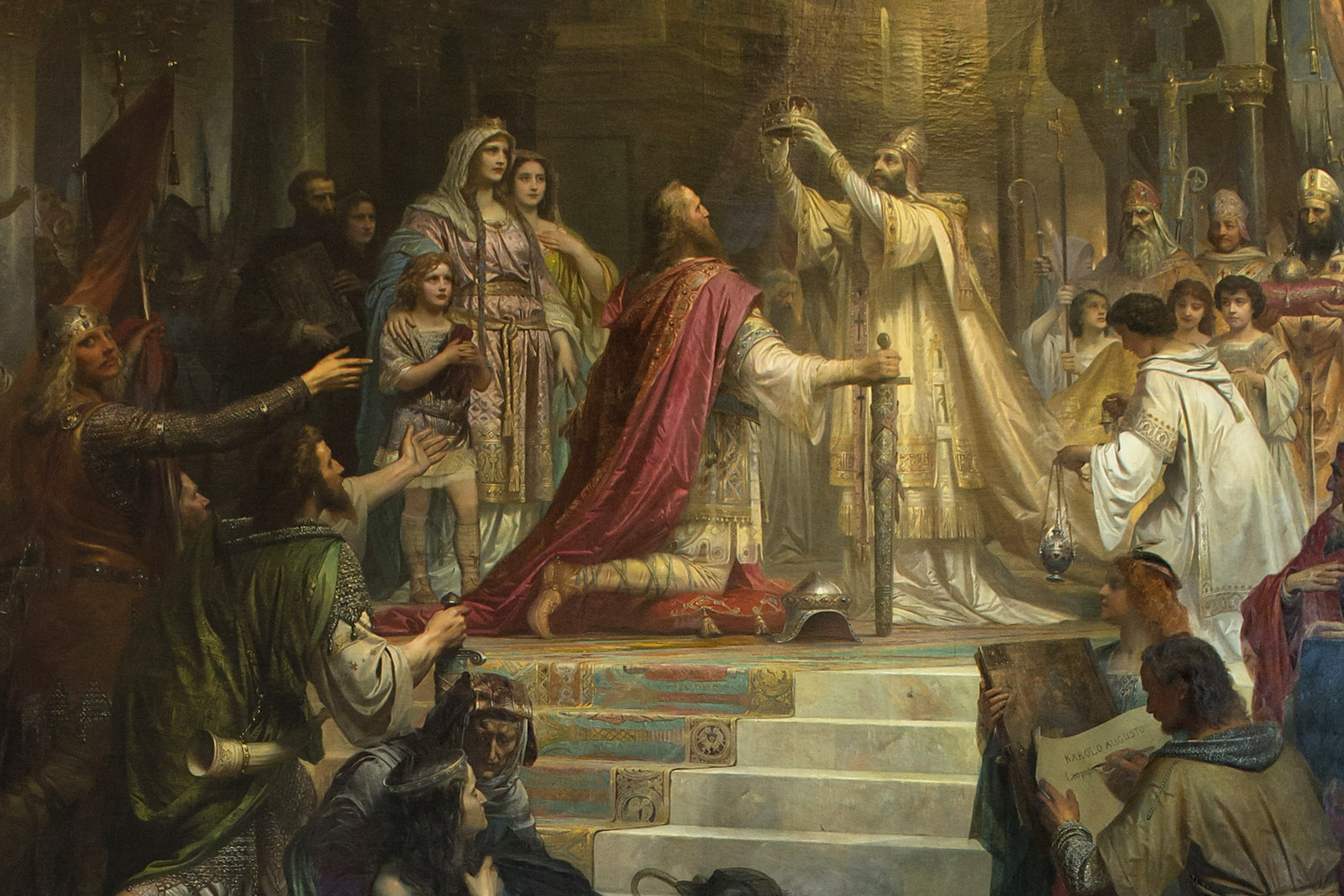
On Winter Solstice in the year 800 CE, Charlemagne was crowned the first Holy Roman Emperor for uniting all of Europe. His coronation took place in the old St. Peter’s Basilica in Rome. The Egyptian obelisk stood quietly outside as a “witness”.
Mosaics of the Egyptian sun-bird in a date palm continued to appear in churches such as the Basilica of Santa Prassede in 828 CE. This mosaic shows a date palm with a phoenix wearing a halo perched on a branch. Both the palm tree and the phoenix were symbols of invincibility.
Note: The word Santa means “Saint” in Italian, based on the Latin word “sanctus“.

In 1197 the remains of Saint Nicholas of Myra, were moved from his church in Myra to the newly built Basilica of St. Nicholas in Bari, a seaport town in southern Italy. From this point on he was known as St. Nicholas of Bari.
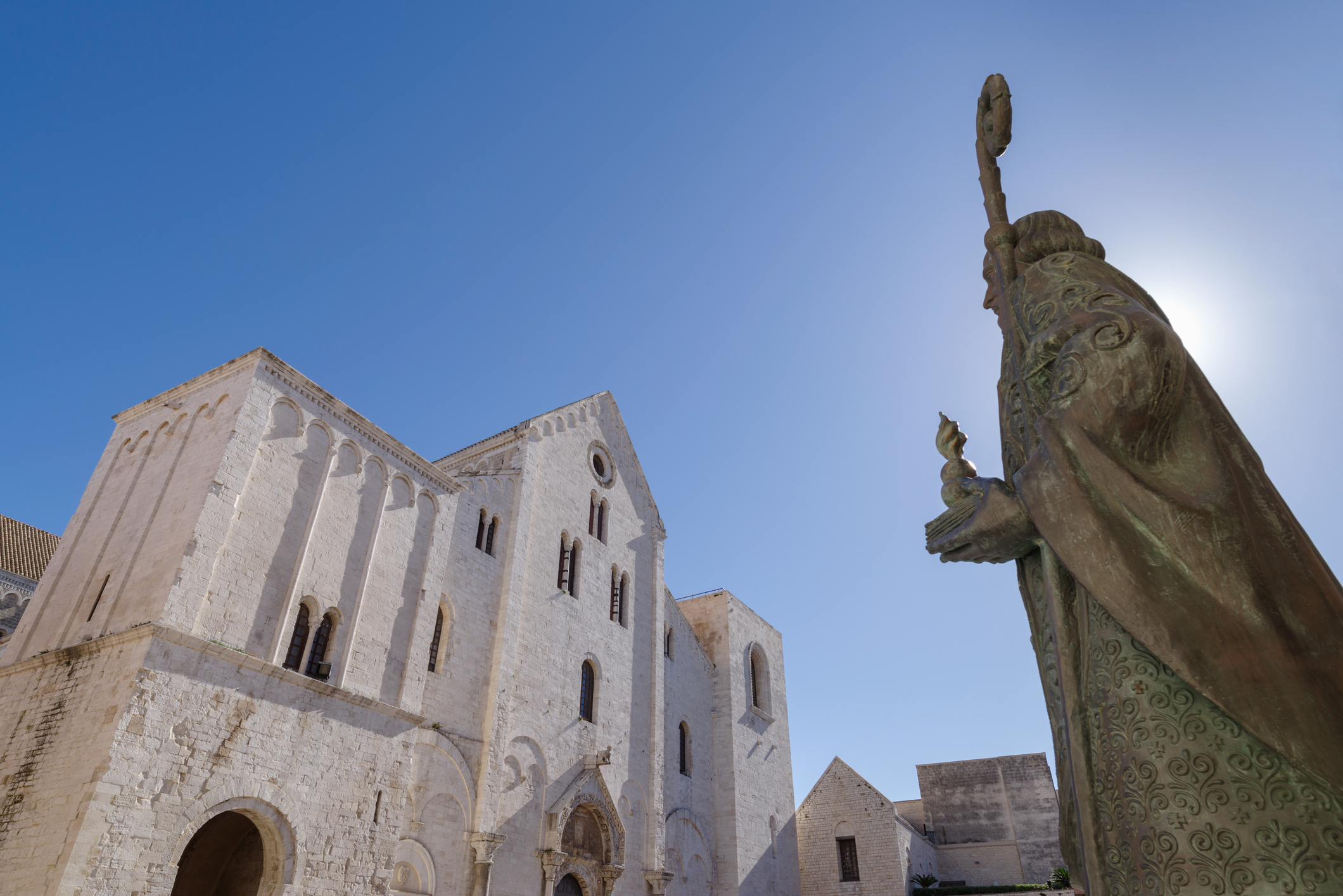
One of the earliest legends of this “gift-giving” Saint was helping a father who couldn’t pay the dowries for his three daughters to marry. At night Nicholas secretly threw three bags of gold coins through his window. When the father thanked Nicholas, Nicholas asked him to keep it a secret. This charitable yet humble gesture inspired the iconography of three golden balls being associated with St. Nicholas.


Right: St. Nicholas of Bari – by Jacoppo Tintoretto – c. 1555
The Renaissance, “rebirth,” spread throughout Europe in the 1400’s and so did the stories of St. Nicholas the “wonderworker”. Artist’s began to create multiple paintings depicting his good deeds and miracles. They even painted him standing next to Mary holding the baby Jesus. Saint Nicholas was celebrated on December 6, during the “Holy Season of Christmas”, which enhanced his legacy as the secretive “Gift Giver”.

In 1517 Martin Luther (b. 1483 – d. 1546), a German Catholic Priest, challenged the Roman Catholic Church and its obsession for venerating Saints over Jesus, and the practice of taking money to reduce one’s sins. His views sparked the beginning of the Protestant Reformation. In 1521 the Pope excommunicated Luther from the church.

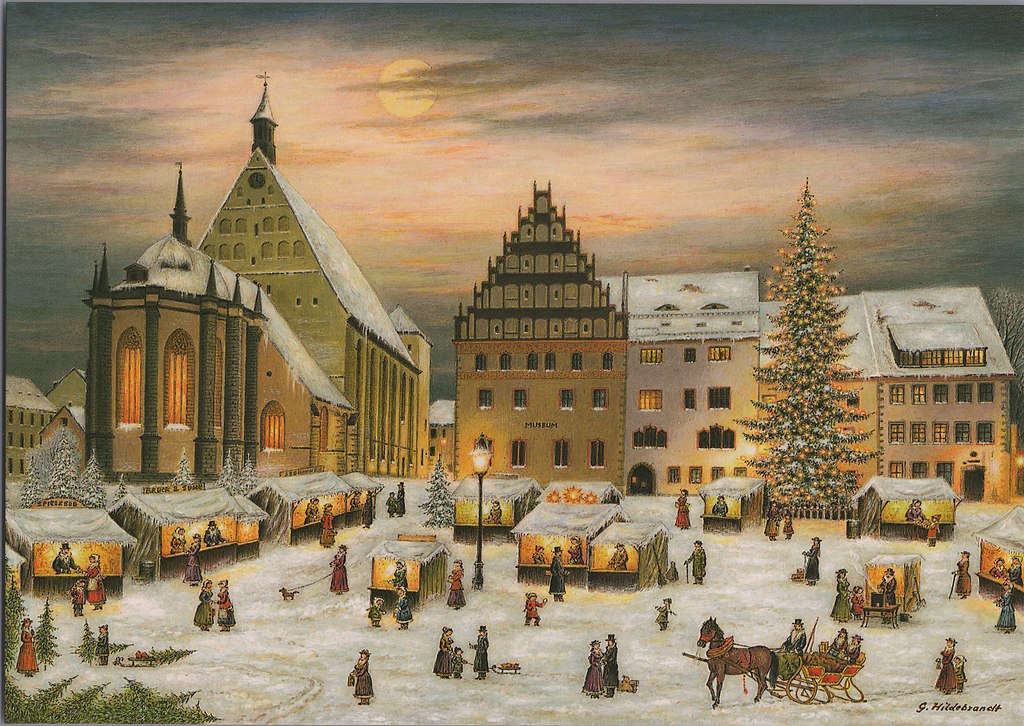
Luther had proposed that St. Nicholas’s Feast Day on December 6 be moved to Christmas Eve on December 24. He also wanted to replace St. Nicholas with the Christkind “Christ-Child” as the “gift-giver”. He encouraged the creation of Christkindlmarkts that would open on the first Sunday of Advent and remain open until December 24.
He was not successful in moving St. Nicholas out of the picture. St. Nicholas Day continued to be celebrated on December 6 throughout Germany, Poland, Belgium. But the tradition of Christkindlmarkts did take hold and they continue to this day.
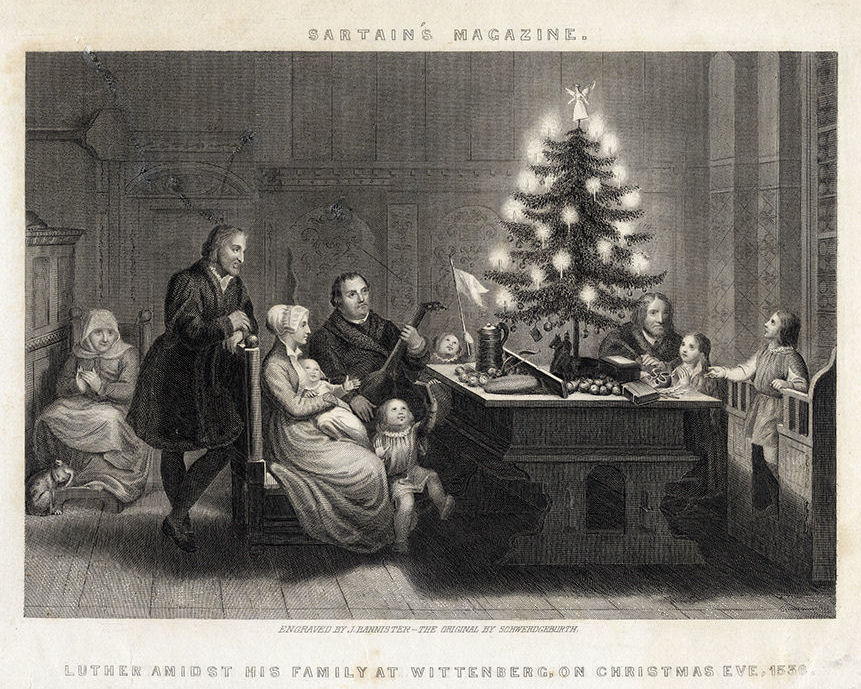
According to legend, Martin Luther was inspired by twinkling stars above some fir trees on a clear December night. This gave him the idea to bring a fir tree into his home and decorate it with candles. He felt this was a way to share the “light” that Jesus gave to the world with his children. Whether this is true or not, the tradition of “Christmas Trees” did begin in Germany, but it took 300 more years for it to become acceptable.
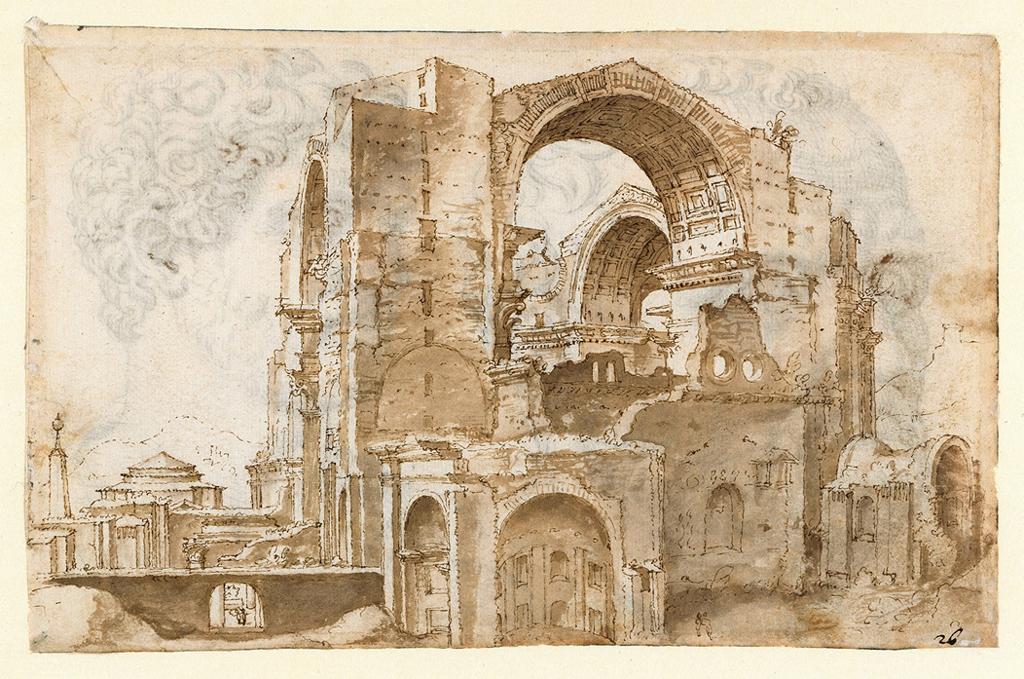
By 1506 the old St. Peters Basilica had fallen into disrepair, the process of tearing it down and building a new Basilica over St. Peter’s grave began. It took 120 years and many Renaissance artists and architects such as Bramante, Raphael, Michelangelo and Bernini to complete it. The obelisk remained in its original place.
During its construction, Pope Gregory XIII (b. 1502-d. 1585) introduced the Gregorian Calendar in 1582, because the Church was focused on keeping the Spring Equinox on March 21 versus its current astronomical date of March 11. To accomplish this, they removed ten days between October 4 and October 15 in 1582. The astronomical date of the Winter Solstice now fell between December 20-21. The Church chose to keep Christmas on its original date of December 25. This effectively separated the Winter Solstice from Christmas for the first time in history.
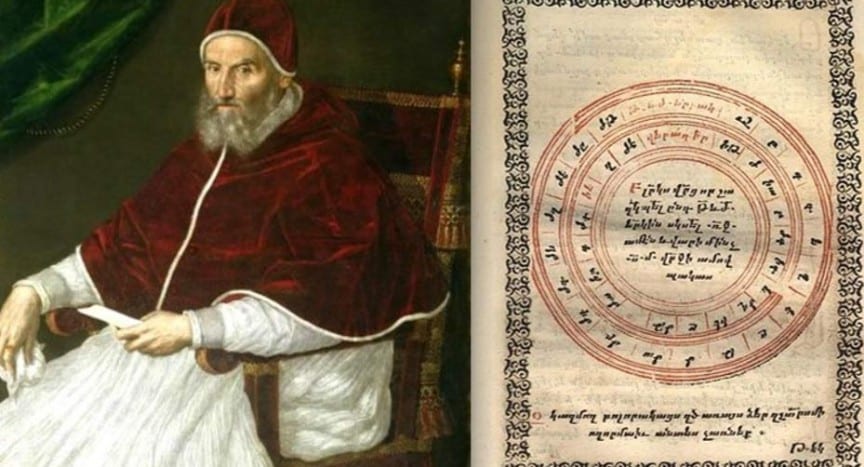
Right: A page from the Gregorian Calendar
In 1586 the ancient Egyptian obelisk was moved 800 feet west of the Basilica under the direction of Italian Architect Domenico Fontana (b. 1543 – d. 1607). The goal was to have it be the centerpiece for the gathering place on the west side of St. Peter’s Basilica. This meant that people gathering around the obelisk faced East toward the rising Sun to honor the Son of God.
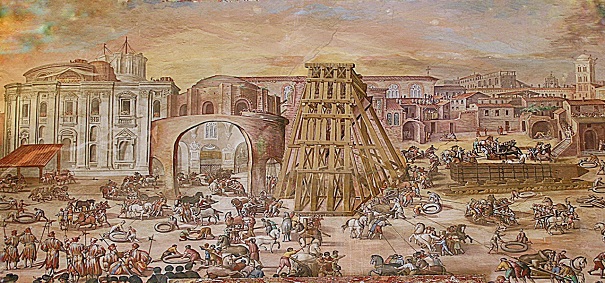
St. Peter’s Square was designed by Gian Lorenzo Bernini, which featured the “Vatican Obelisk” in the center. The surrounding colonnades were created to welcome people into the embrace of the “Maternal Arms of Mother Church”. Construction began in 1656 and ended 1667.

In 1817, circular stones were inlaid to mark the tip of the obelisk’s shadow at noon, which were aligned to the twelve signs of the Zodiac.

Sixteen additional stones were inlaid to represent the directions of the Wind Rose Compass. This along with radiating lines of white travertine marble allowed the obelisk to function as a sundial, an astronomical clock and a compass.

In the 1600’s the English began to resurrect their old “Yuletide” traditions through “Father Christmas” based on Wodin/Odin as the “All-Father.” Father Christmas would deliver presents on Christmas Eve with the help of a Yule goat, related to his son Thor. Boughs of Holly, the sacred plant of Frau Holle, continued to be a popular holiday decoration. Twigs of mistletoe were hung in doorways for protection and good luck, while Yule logs were cut down to size for Yuletide fires.

In the Netherlands they began to call Saint Nicholas, Sinterklas, as an affectionate abbreviation. Children would place their wooden shoes or boots outside their bedroom door on the night of January 5th in hopes that they would be filled with gifts from Sinterklas the next morning.
Nicolaes Witsen (1641-1717) was born in Amsterdam and named for St. Nicholas, the patron saint of Amsterdam. Witsen was a renowned author, cartographer, artist, historian and statesman. He was the mayor of Amsterdam and director of the Dutch East India Company.
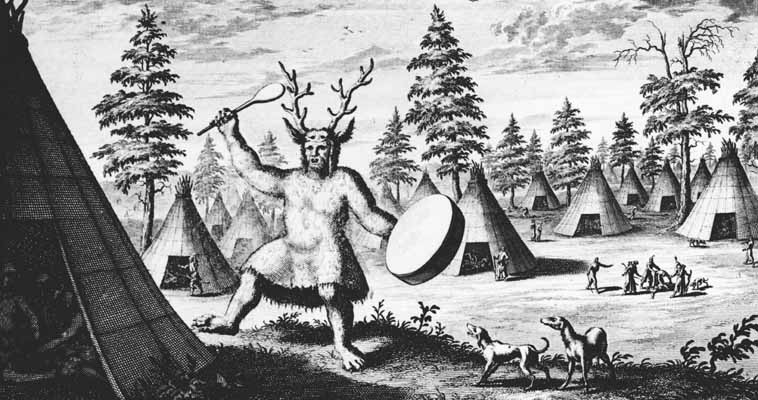
Witsen traveled throughout India, China and Russia studying religious icons. He is responsible for bringing the word “shaman” into the English language as well as the stories of these reindeer people and their connection to trees.
When Dutch settlers came to New Amsterdam (present day New York) in the 1600’s they brought their custom of St. Nicholas and Sinterklaas to America.

When the British took control of New Amsterdam in 1664 they celebrated the Yuletide season by introducing Father Christmas to the colonies and shared the singing of English Christmas Carols.

The Germans brought their traditions of the Christkind, which translates to Kris Kringle along with the Christmas tree. Eventually all of these traditions blended together to create Santa Claus.

In 1821 an anonymous poem titled: A New-year’s present, to the little ones from five to twelve, provided the first vision of “Sante claus” dressed in red and riding a sleigh pulled by a flying reindeer. Sante claus carries a “birchen rod” made from birch twigs to punish “naughty” children, while his sleigh is filled with “rewards” for “good” children. The illustration also includes an obelisk-shaped marker pointing to the North Pole.

Inspired by these poems, Clement Moore, an Episcopal priest, wrote A Visit from St. Nicholas in 1823. He claims he wrote it while riding in a sleigh on a snowy winter day. His vision of St. Nicholas descending down a chimney was inspired by a Dutch handyman. The reindeer Donder and Blitzen came from the Dutch and German words for thunder and lightning, which may be related to Thor’s goats who bring the Sun on the Winter Solstice. The eight tiny reindeer may come from Odin’s eight-legged horse. Moore originally wrote this poem for his seven children, which became the classic Christmas story, Twas The Night Before Christmas.

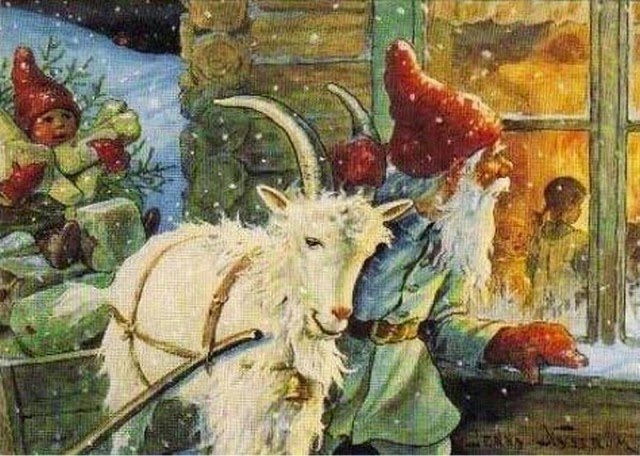
Swedish painter Jenny Nystrom (1854 – 1946) illustrated postcards of the Jultomte (yule gnome) and his Julbock (yule goat) pulling a wagon full of gifts on Christmas Eve. The Jultomte is the Swedish version of Santa Claus, which takes us back to the magical of nature of the Winter Solstice.
The Christmas trees we know today originated in Germany among the Protestant households of the upper Rhine region. Prince Albert, grew up in Bavaria, where Christmas trees were a family tradition. Apples, pears, nuts and other natural adornments were used as decoration.
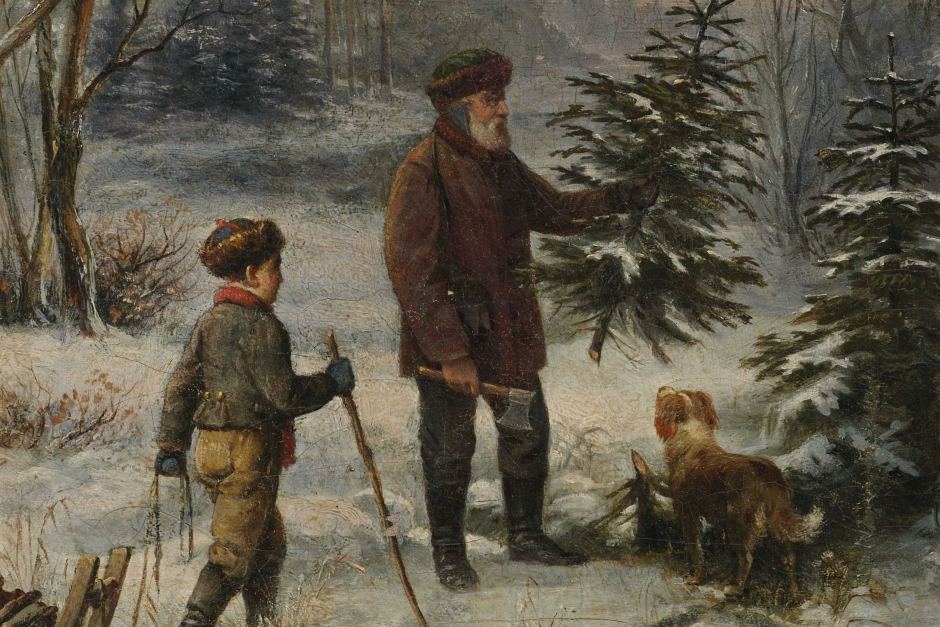
Most people resisted bringing an evergreen tree into their home in fear that it was a “pagan” practice. During the Victorian Era (1837 – 1901), an illustration of Queen Victoria and Prince Edward’s candle-lit fir in Windsor Castle was featured in The Illustrated London News. This signaled that the “Christmas Tree” was accepted by the Queen herself. Its popularity sky-rocketed in England and across the pond to the America’s.

Today evergreen trees are a welcome addition to the holiday season. In the United States alone, approximately 25-30 million firs, spruce, pines and cypress trees are bought each year. 98% are grown on tree farms.

The origins of this story are on full display at St. Peter’s Square, Rome, Italy. In 1982 Pope John Paul II began the tradition of decorating a Christmas tree in St. Peter’s Square next to the “Vatican Obelisk.” Here is an ancient Egyptian obelisk inspired by a date palm, which functions as a pole that is anchored to the North Star, to herald the time when the Sun is born. This “date palm” stands next to an “evergreen” Christmas Tree. Both were once considered to be “pagan” symbols, yet here they are, reminding us of our roots and how nature guides our soul.

As we celebrate this holiday season let’s honor the magical history it represents and the many gifts nature provides. By understanding the history behind these gifts we open ourselves to a deeper appreciation of nature and the unlimited realms of the human spirit.
“Come out of the circle of time and into the circle of love” – Rumi


Dear Laurel
How so very lovely to receive this a this time.
Do you have knowledge of trees and traditional ways in Africa?
Love Joanna
>
LikeLike
Hi Joanna, I do have some trees that are unique to Africa listed in the “Tree Spirit Wisdom” section. They are in alphabetical order; Acacia/Vachellia, Baobab, Date Palm and Sycomore Fig. I also added Kwanzaa, which originated in Africa as a “First Fruits” festival during the month of December. Even though it is a Summer Solstice celebration in Africa, it has been turned into a Winter Solstice celebration in North America. I hope that helps. If there are certain trees you are interested in or holidays that you know of please feel free to share 🙂 Love and Peace, Laural
LikeLike